
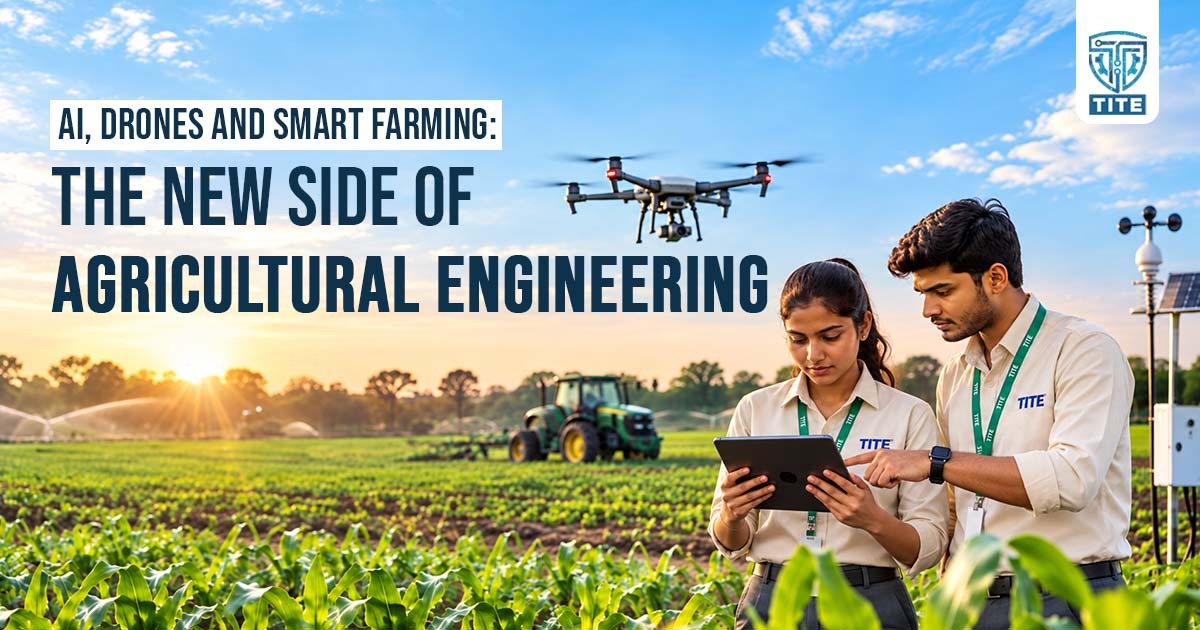
AI, Drones and Smart Farming: The New Side of Agricultural Engineering
A farm does not become “smart” because a drone flies over it or a sensor is placed in the soil. It becomes smarter when those tools help answer practical questions: Does this field need water today? Where is the crop under stress? Is an input being used where it is actually needed?
That change is already happening at scale in India. By July 2026, more than 10.18 crore Farmer IDs had been created, while satellite imagery and digital crop surveys were being used for crop and agricultural planning. For students considering Agricultural Engineering colleges in Odisha, this gives the field a very different character from the one many people still imagine.
Read the latest Digital Agriculture Mission update
The Change Is Really About Better Farm Decisions
Agricultural Engineering has always dealt with practical systems: tractors, irrigation, water flow, farm equipment, soil and post-harvest processing.
What is changing is the information available around those systems.
A pump can now respond to soil-moisture data. A drone can show parts of a field that need attention. GIS can bring soil, crop and location information together on one map.
| Farm Decision | Earlier Approach | What Smart Farming Adds |
|---|---|---|
| When should I irrigate? | Schedule and field observation | Soil and weather data |
| Where is the crop stressed? | Walking through the field | Drone and satellite imagery |
| Where should an input be applied? | Uniform application | Location-specific information |
| Is there a pest problem? | Visual identification | AI-supported image analysis |
| How is produce being stored? | Periodic manual checks | Continuous sensor monitoring |
For an Agricultural Engineer, that means the job is gradually moving from simply operating systems to making those systems more responsive.
Decision 1: Does the Crop Actually Need Water Today?
Irrigation is a good example of why “smart farming” is not just a technology buzzword.
Traditionally, water may be applied according to a schedule or visual assessment. But two parts of the same field may not have exactly the same moisture condition.
A soil-moisture sensor can provide another layer of information. When that data is combined with weather, crop requirements and irrigation knowledge, water can be applied more carefully.
The Agricultural Engineer still needs to understand pumps, water movement, irrigation design and field conditions. The sensor does not replace that knowledge. It helps the engineer make a better-timed decision.
This is one reason precision agriculture is becoming important. ICAR’s National Programme on Precision Agriculture now involves 16 research institutes and includes sensor-based irrigation, AI, IoT, drones and remote sensing.
Read ICAR’s latest precision-agriculture update
Decision 2: Which Part of the Field Needs Attention?
A farmer walking through a field sees what is happening close by. A drone can provide a very different view.
From above, variations can become easier to notice. One area may show signs of stress while another appears healthy. Water distribution, crop growth or other visible patterns may also differ across the field.
The useful part is not the drone itself. It is what happens after the flight.
Images need to be interpreted, compared with field conditions and turned into a useful recommendation. An Agricultural Engineer may therefore work with both the physical farm and the information collected from above.
Current precision-agriculture research in India already combines ground sensors, drones, satellite platforms, AI and ICT for crop and soil-health monitoring.
That makes drone technology less of a standalone skill and more of one tool within a larger engineering system.
Decision 3: Can We Apply Inputs More Precisely?
One of the basic ideas behind precision farming is simple: every part of a field may not need exactly the same treatment.
If one area needs attention and another does not, applying the same amount everywhere can mean unnecessary cost and resource use.
Drones, sensors and field data can help identify those differences. The engineering challenge is then to connect that information with the equipment or process used for application.
That is where machinery knowledge still matters.
An engineer working around precision application needs to understand not only the digital map or drone output, but also how equipment behaves in real field conditions.
The result is a different way of looking at farm mechanisation: not simply how quickly can the job be done, but how accurately can it be done?
Decision 4: Can a Pest Problem Be Spotted Earlier?
This is where AI becomes much easier to understand.
Imagine a farmer or extension worker photographing an unfamiliar pest. Instead of waiting for manual identification, an AI-supported system can compare the image with known patterns and help narrow down the problem.
India is already using this approach.
The National Pest Surveillance System uses AI and machine learning for pest detection and is currently used by more than 10,000 extension workers. The system supports 66 crops and more than 432 pest types.
AI here is not replacing agricultural knowledge.
It is shortening the distance between seeing a problem and knowing what it may be.
For students, that distinction matters. Agricultural Engineering is not becoming a computer-science course. Instead, engineers increasingly work with digital tools that sit alongside machinery, irrigation, soil and crop systems.
Decision 5: What Happens After the Crop Leaves the Field?
Smart agriculture does not stop at harvesting.
Produce still has to be stored, handled and processed. Temperature, humidity and storage conditions can affect quality after the crop has left the field.
This is another area where sensors and IoT can make a quiet but useful difference.
ICAR’s precision-agriculture work currently includes sensor-based post-harvest quality monitoring for commodities such as mango, banana, pulses and rice, along with controlled-environment and cold-storage applications.
For an Agricultural Engineering student, this connects digital technology with Agricultural Process Engineering.
The same principle appears again: understand the physical process first, then use technology to monitor or improve it.
So, What Does an Agricultural Engineer Need to Know Now?
The answer is not “everything about AI”.
A student still needs the traditional engineering foundation. Machinery needs mechanical understanding. Irrigation needs knowledge of water. Processing needs knowledge of materials, equipment and post-harvest systems.
Digital tools become useful on top of that foundation.
A modern Agricultural Engineer may increasingly need to be comfortable with:
- interpreting basic sensor data
- reading maps and spatial information
- understanding how drones collect field data
- working with automated systems
- comparing digital information with actual field conditions
The important skill is connecting the digital output with the engineering problem.
That is very different from simply knowing how to operate a gadget.
Where Does TITE Fit Into This?
Students comparing B.Tech Agricultural Engineering colleges in Odisha should look for a programme that does not treat traditional engineering and smart farming as two separate worlds.
TITE’s current Agricultural Engineering programme covers farm machinery, irrigation, soil science and agricultural processing, while also highlighting precision agriculture and technology-led farming. Its practical facilities include tractor operations, farm machinery, hydraulics, soil and Agricultural Process Engineering labs.
View TITE’s B.Tech Agricultural Engineering programme
That combination matters. Students need to understand how a tractor works before thinking about automation, just as they need to understand irrigation before designing a sensor-based water-management system.
What Could Students Actually Build or Work On?
Smart-farming projects do not have to involve a fully automated farm.
In fact, smaller projects often make more sense because students can understand every part of the system.
| Project Idea | The Real Question Behind It |
|---|---|
| Soil-moisture-based irrigation | Can water be applied only when the soil needs it? |
| Drone crop-stress mapping | Can stressed areas be identified earlier? |
| GIS field mapping | Can spatial differences in a field be made visible? |
| Smart storage monitoring | Can temperature or humidity problems be caught sooner? |
| AI-based pest image classification | Can an image help identify a likely crop problem? |
What makes these projects useful is not the technology in the title. It is the problem being solved.
A small sensor project that produces reliable information can be far stronger than an elaborate “AI smart farm” model that nobody on the team can fully explain.
Smart Farming Is Creating Different Career Paths Too
The career possibilities around Agricultural Engineering are also becoming wider.
Traditional areas such as farm machinery, irrigation, processing and technical services remain relevant. Smart farming adds new spaces around precision agriculture, GIS, automation, drone-supported services and agri-tech.
A student interested in machinery may move towards automated equipment. Someone interested in irrigation may work with sensor-led water systems.
A student who enjoys maps and field data may find precision agriculture or GIS more interesting.
| If You Like... | A Direction to Consider |
|---|---|
| Machinery and equipment | Farm mechanisation and automation |
| Water systems | Smart irrigation and water management |
| Maps and field data | GIS and precision agriculture |
| Crop monitoring | Drone and remote-sensing applications |
| Processing and storage | Sensor-led post-harvest systems |
The technologies overlap, which means careers may not fit neatly into one traditional subject area anymore.
What Should Students Check Before Choosing a Programme?
Students looking at Agricultural Engineering colleges in Bhubaneswar should look beyond whether the college mentions “AI” or “smart farming” on a page.
Ask what students actually get to work with.
Are machinery and irrigation taught practically? Is there field exposure? Do students get opportunities to work with modern agricultural systems and project-based learning?
Those questions tell you much more than technology terminology alone.
For students ready to compare programmes and intake details, TITE currently lists Agricultural Engineering among its four-year B.Tech programmes for the 2026–27 admission cycle.
Check TITE B.Tech Admissions 2026–27
The Farm of the Future Still Needs Someone Who Understands the Farm
Technology can tell you that soil moisture has dropped. It cannot automatically tell you whether the entire irrigation system makes sense for that field.
A drone can show an unusual pattern. Someone still has to decide whether it comes from pests, water stress, soil conditions or something else.
That is why Agricultural Engineering remains important.
AI, drones and sensors are making more information available, but somebody still has to connect that information with water, machinery, soil, crops, cost and actual farm conditions.
For students considering B.Tech Agriculture Engineering in Odisha, that may be the most interesting part of the field in 2026.
The future Agricultural Engineer may spend less time simply asking, “Does the machine work?” and more time asking, “Is the whole system making the right decision?”
Frequently Asked Questions
Is AI really being used in Indian agriculture?
Yes. Current government applications include pest surveillance, crop identification, farmer advisories, crop insurance and agricultural analytics.
What do drones help with in smart farming?
Drones can support crop monitoring, remote sensing, field imagery and precision application. Their real value comes from turning field information into better decisions.
Does Agricultural Engineering now include IoT and sensors?
These technologies are increasingly relevant to irrigation, controlled environments, post-harvest monitoring and precision farming.
Do Agricultural Engineers need to become AI programmers?
Not necessarily. Engineers need to understand how digital tools fit into agricultural systems. Programming becomes more important only for specialised technology-focused roles.
Is smart farming a useful career direction?
It can be, especially for students interested in the overlap between machinery, water management, GIS, automation, sensors and agricultural data.
