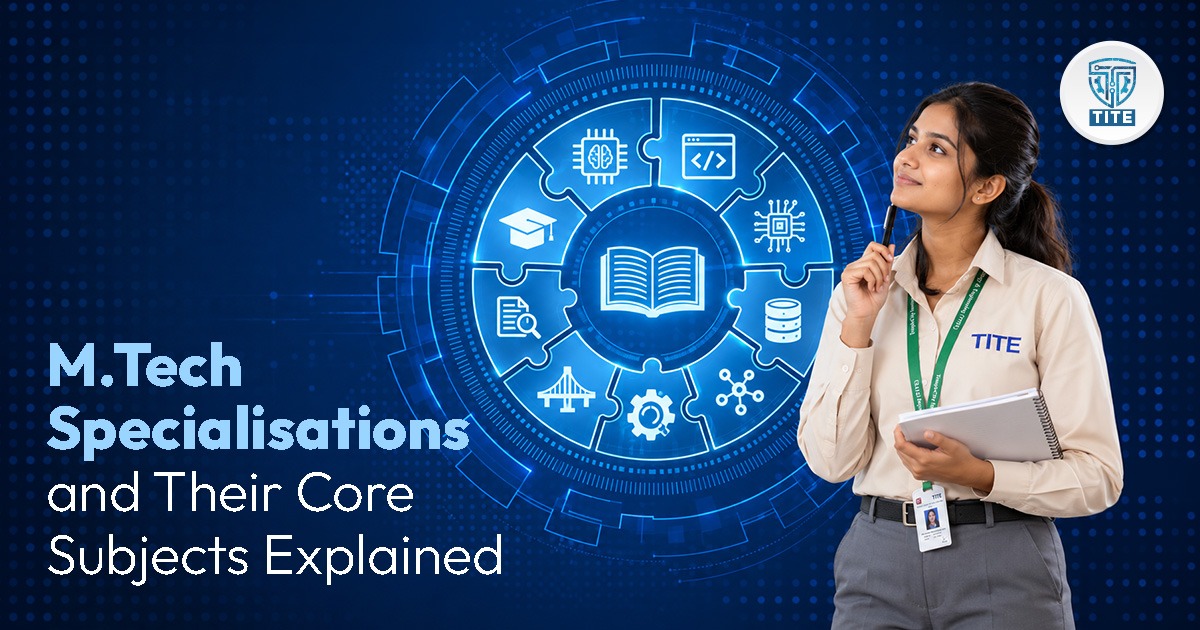
MTech Specialisations and Their Core Subjects Explained
India’s engineering job market is becoming more specialised. According to Naukri JobSpeak, white-collar hiring grew 8% in FY26, while AI and ML hiring rose 45% during the year. Fresher hiring also increased 16% year-on-year in March 2026.
For students comparing MTech colleges in Odisha, this makes postgraduate specialisation more relevant. TITE offers MTech programmes in Computer Science and Engineering, Electrical Engineering, Electronics and Communication Engineering, Mechanical Engineering, and Civil Engineering.
The real decision is not which branch sounds more popular. It is which one gives you the technical depth you want after B.Tech.
Start With the Kind of Engineer You Want to Become
An MTech should build on your undergraduate foundation rather than repeat it. Before choosing a branch, think about the subjects you enjoyed, the projects that held your interest and the kind of technical problems you want to work on.
Ask yourself:
- Which BTech subjects interested me most?
- Do I prefer software, systems, design or infrastructure?
- Am I more interested in industry, R&D or higher studies?
- Which technical area do I want to understand in greater depth?
These questions make it easier to compare M.Tech courses in Odisha with a clear purpose.
MTech in Computer Science and Engineering
Best suited for: Students interested in advanced computing, software systems, AI and data.
Key areas can include:
- Advanced algorithms
- Artificial intelligence
- Machine learning
- Data science
- Cloud computing
- Cybersecurity
This programme can suit students who want to move beyond general programming into advanced software, intelligent systems, data-led technologies or computing research.
MTech in Electrical Engineering
Best suited for: Students interested in power, energy, control systems and automation.
The programme can cover:
- Advanced power systems
- Control systems
- Power electronics
- Renewable energy
- Smart technologies
- Electrical simulation
Electrical Engineering is a strong fit for students who enjoyed power systems, machines or control during BTech and want to study modern energy and electrical systems in greater depth.
MTech in Electronics and Communication Engineering
Best suited for: Students interested in electronics, communication systems, embedded devices and VLSI.
Key areas may include:
- Digital communication
- Signal processing
- VLSI design
- Embedded systems
- Wireless communication
- RF and microwave engineering
For students comparing MTech specialisations in Odisha, ECE can be a good choice when their interests lie in the electronics and communication technologies behind modern connected systems.
MTech in Mechanical Engineering
Best suited for: Students interested in design, manufacturing, thermal systems and automation.
Areas of study may include:
- Advanced mechanical design
- Manufacturing technologies
- Thermal engineering
- CAD and CAM
- Robotics
- Automation
This branch suits students who enjoy understanding how machines and systems are designed, manufactured, tested and improved.
MTech in Civil Engineering
Best suited for: Students interested in structures, construction and infrastructure.
The programme can cover:
- Advanced structural analysis
- Geotechnical engineering
- Construction management
- Structural design
- Sustainable construction
- Advanced modelling
Civil Engineering can be a suitable postgraduate path for students interested in advanced design, infrastructure, construction, technical consultancy or research.
Which MTech Programme Matches Your Interests?
The five programmes lead towards very different areas of engineering.
| MTech Programme | Strong Fit For | Key Areas |
|---|---|---|
| Computer Science and Engineering | Computing and intelligent systems | AI, ML, Data, Cloud, Cybersecurity |
| Electrical Engineering | Power and energy systems | Power, Control, Renewables, Automation |
| Electronics and Communication Engineering | Electronics and communication | VLSI, Embedded Systems, Wireless, DSP |
| Mechanical Engineering | Design and manufacturing | CAD/CAM, Robotics, Thermal, Automation |
| Civil Engineering | Structures and infrastructure | Structural, Geotechnical, Construction |
There is no single branch with the “best” scope for every student. The stronger choice is the one that matches your existing engineering background and the technical direction you want to pursue.
Check the MTech Syllabus Before Applying
Once you have shortlisted a branch, check what you will actually study.
Students considering BPUT-affiliated institutions can refer to the official BPUT syllabus section for available postgraduate curriculum information and academic updates.
Look beyond the course title and check:
- Core subjects
- Electives
- Laboratory components
- Project requirements
- Research methodology
- Dissertation work
This is especially important when comparing MTech courses in Odisha, because two programmes with similar names can differ in their academic focus.
What Matters Beyond the Syllabus?
Postgraduate engineering should involve more than classroom learning. The quality of laboratories, projects and research guidance can influence how deeply students engage with their chosen field.
When comparing the best MTech colleges in Odisha, look at:
- Faculty expertise
- Advanced laboratories
- Research opportunities
- Project guidance
- Dissertation support
- Technical infrastructure
- Industry interaction
A strong MTech environment should give students enough opportunity to apply advanced concepts rather than studying them only for examinations.
Should You Choose MTech Immediately After BTech?
Not every engineering graduate needs to pursue MTech immediately.
Continuing directly can make sense if you already know which technical area you want to specialise in. Students who are still unsure may benefit from first understanding what kind of engineering work interests them.
An MTech becomes a clearer choice when you know what you want to learn more deeply and why that expertise matters to your future plans.
How to Shortlist MTech Colleges in Odisha
Once the specialisation is clear, compare colleges specifically for that branch.
A CSE student may prioritise computing infrastructure and advanced software work. An ECE student should look closely at electronics and communication laboratories. Mechanical and Civil students may place greater emphasis on design, testing and specialised technical facilities.
For students searching for MTech colleges in Odisha, the most relevant factors are:
- Strength of the chosen department
- Faculty expertise
- Relevant laboratories
- Curriculum depth
- Projects and dissertation support
- Research environment
- Industry exposure
This gives a much clearer picture than comparing colleges only through general campus facilities.
Choose Depth, Not Just Another Degree
An MTech is most valuable when it helps you move from broad engineering knowledge towards deeper expertise in one area.
At TITE, students can choose from MTech programmes in Computer Science and Engineering, Electrical Engineering, Electronics and Communication Engineering, Mechanical Engineering, and Civil Engineering. Each pathway leads towards a different set of technical problems, subjects and career directions.
Choose the programme that gives you a reason to go deeper. The right MTech should help you build expertise in a field you can see yourself working, researching and progressing in over the years ahead.
Frequently Asked Questions
1. Which MTech courses does TITE offer?
TITE offers MTech in CSE, Electrical Engineering, ECE, Mechanical Engineering and Civil Engineering.
2. Which MTech specialisation is best?
There is no single best option. The right branch depends on your background, interests and career goals.
3. What should I check before choosing an MTech college?
Compare the syllabus, faculty, laboratories, projects, research support and industry exposure.
4. Should I check the MTech syllabus before applying?
Yes. It helps you understand the subjects, electives, projects and academic depth of the programme.
5. Is MTech useful only for research?
No. It can also support specialised engineering roles, R&D, industry, consultancy and higher studies.
