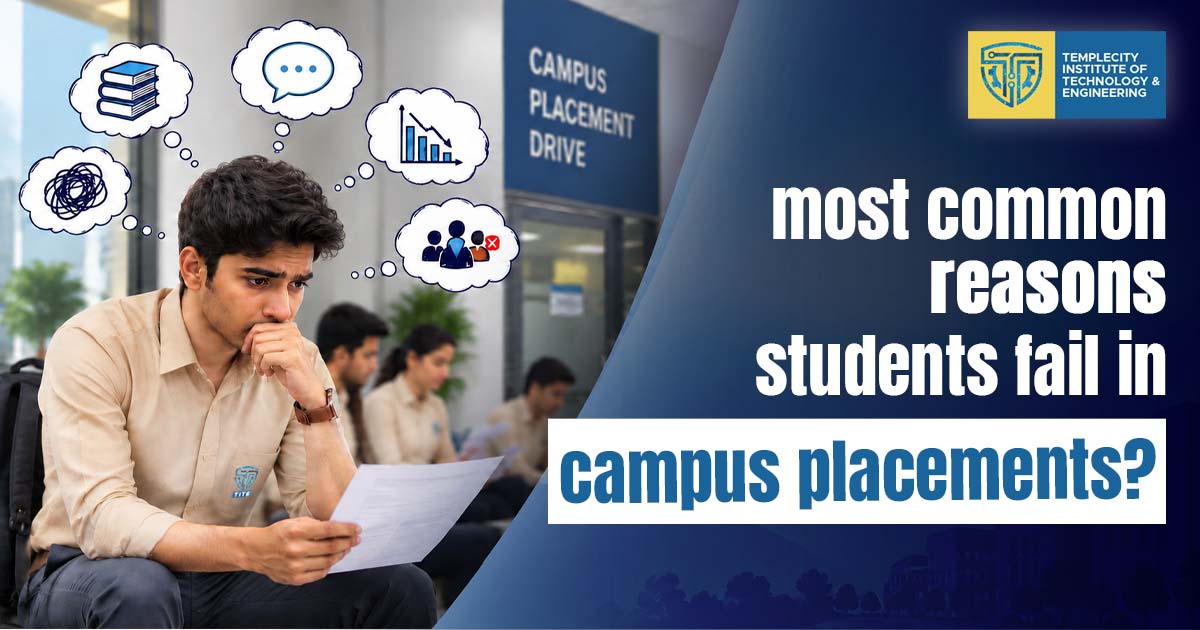
What are the most common reasons students fail campus placements?
Entering recruitment season feels like stepping onto a high-stakes arena, carrying the heavy burden of family expectations and career aspirations. For students navigating the engineering colleges in odisha list, the intense pressure can turn every campus drive into an all-or-nothing test. However, rejection rarely signifies a lack of potential. Campus recruitment is simply an exercise in strategy, where missteps often stem from fixable flaws rather than insufficient academic capability.
The belief that only top academic scorers secure job offers is a persistent myth. Real success depends on how effectively you translate classroom learning into practical talent. For instance, institutions like TITE focus heavily on practical skill delivery over simple rote memorization. When students align their preparation with actual industry demands, they discover that rejection is not an assessment of intelligence, but a prompt to adjust their strategy.
Statistical realities underscore this strategic focus: national tracking data reveals that fewer than 50% of engineering graduates successfully secure roles during campus drives. Surprisingly, technical skill gaps account for only a fraction of failures, whereas aptitude screening filters out over 60% of candidates before technical interviews even begin. Viewing placement as a structured process rather than a roll of the dice allows you to address these specific bottlenecks and turn initial setbacks into job offers.
Treating the Aptitude Test as an Afterthought
Treating the general aptitude test as a minor hurdle is one of the most common and fatal strategic mistakes students make during campus recruitment. Candidates frequently spend months perfecting Data Structures and Algorithms (DSA), building complex full-stack apps, or reviewing core engineering theories, while completely ignoring quantitative reasoning, logical deduction, and verbal mechanics.
The critical flaw in this approach stems from a misunderstanding of how hiring funnels operate. Aptitude tests are rarely designed to measure how brilliant you are in your field; they are mass elimination filters deployed to manage volume. When thousands of students apply for a few dozen open positions, recruiters use strict percentile cutoffs on initial online assessments (OAs) to shrink the applicant pool to a manageable size. If you score 40% on a time-pressured quantitative section, your test ends instantly. The ATS software automatically rejects your application before a human recruiter or technical interviewer ever opens your resume, sees your GPA, or reviews your GitHub repositories.
The Student Fix: Structured, Timed Pattern Practice
Overcoming this bottleneck requires moving away from last-minute memorization and shifting toward building real speed and pattern recognition.
- Commit to Timed Daily Drills: Aptitude failure is almost never a problem of ability; it is a problem of time. Allocate 30 to 45 minutes every day specifically to solve 15–20 questions under strict time limits. Practice high-frequency placement topics such as Percentages, Time & Work, Data Interpretation, Blood Relations, and Syllogisms.
- Learn Mental Shortcuts & Elimination: In a standard 60-minute test with 60 questions, attempting every problem with step-by-step algebra will guarantee failure. Practice working backward from answer choices, applying estimation tricks, and learning to skip time-sink questions immediately.
- Simulate the Exam Environment: Leverage dedicated placement preparation resources like IndiaBIX to take topic-wise quizzes and timed mock tests. Practicing in a timed browser environment conditions your mind to maintain focus and speed under pressure, ensuring that your technical talents actually get the chance to be seen.
The "One-Size-Fits-All" Resume
One of the most widespread traps candidates fall into during recruitment season is treating their resume like a static, universal pamphlet. Driven by tight deadlines, students frequently draft a single document and blast it indiscriminately to dozens of companies submitting the exact same profile for a Full-Stack Developer role at a product startup, a Data Analyst position at a consultancy, and a Core Systems role at an MNC.
This spray-and-pray approach breaks down immediately when faced with modern recruitment workflows. Companies visiting premier engineering colleges in Bhubaneswar handle thousands of applicants and rely heavily on Applicant Tracking System (ATS) software to pre-screen profiles before a human ever looks at them. When your resume contains vague, generalized statements like "Worked on web development projects" or lacks the specific framework keywords explicitly requested in the job description, the ATS assigns a low match score. Even if a human recruiter scans it, a generic resume fails to signal genuine interest or specialized competency, causing your profile to be discarded within seconds.
The Student Fix: Targeted, High-Impact Formatting
Fixing a weak resume does not require inventing fake experience; it requires presenting your actual work with precision, impact, and alignment.
- Tailor Keywords to the Job Description: Before applying, scan the company's job posting for core requirements. If a role emphasizes REST APIs, Docker, and PostgreSQL, ensure those exact technical terms appear prominently in your skills and project sections rather than burying them under generic terms like Database Management.
- Quantify Your Achievements: Move away from listing basic responsibilities (e.g., "Created a user login system") and reframe them as measurable outcomes. Write achievement-focused bullet points instead: "Engineered an authentication module using Node.js, reducing API response times by 20% and handling 500+ daily mock requests."
- Enforce a Strict 1-Page Constraint: As a fresher, your resume should never exceed a single page. Cut out fluff like personal hobbies, outdated high school achievements, or verbose objective statements. Use clean, single-column templates like Jake's Resume (Overleaf) to keep your layout scannable, ATS-friendly, and visually sharp.
Surface-Level Technical Knowledge
Rote learning is a catastrophic trap in technical placement interviews. Candidates often spend weeks memorizing standard definitions, copying popular GitHub projects line-by-line, or memorizing solutions to top algorithmic problems. While this approach might help pass a basic multiple-choice quiz, it completely fails during face-to-face technical rounds.
The breakdown happens because real interviewers rarely ask for simple definitions; they test your architectural reasoning, tradeoffs, and edge-case handling. When asked to explain a project, a student who memorized theory will describe what the tech stack is, but fail when asked why they chose MongoDB over PostgreSQL, or how their API handles high concurrent traffic. Technical interviewers purposely ask probing follow-up questions to test whether you truly understand the core mechanics or simply memorized a solution. The moment a candidate gives a canned answer and stumbles on a basic follow-up, the interviewer marks them as high-risk.
The Student Fix: Build First-Principles Clarity
To convert theoretical knowledge into real technical depth, adjust your preparation from passive reading to active, practical explanation.
- Practice "Feynman Technique" Code Walkthroughs: Never just push code to GitHub and forget it. Sit down with a peer, open your project repository, and explain your code line-by-line out loud. Explain the underlying flow: how data moves from the frontend payload to the database layer and back.
- Master Tradeoffs & Alternatives: For every core tool, algorithm, or data structure you use, learn its trade-offs. Ask yourself: Where does this approach fail? What are its memory or time constraints? What alternative could I have used instead?
- Normalize Professional Honesty: Interviewers appreciate intellectual honesty over fake confidence. If faced with an unfamiliar concept, avoid bluffing. Instead, say: "I haven't worked with that specific library yet, but based on my knowledge of synchronous vs. asynchronous processing, I would approach solving it by..." This demonstrates critical problem-solving skills rather than panic.
- Leverage Pair Programming Environments: Practice live problem-solving using platforms like CoderPad or peer-to-peer mock tools. Explaining your thought process while typing code trains your brain to communicate clearly under pressure.
Zero Company Context
Entering an interview room without researching the company is an immediate dealbreaker for recruiters. Driven by intense competition and back-to-back interview schedules, candidates often focus entirely on their own resumes while treating the target company as an interchangeable background element. Whether interviewing for an enterprise tech giant or a fast-growing startup, treating a firm as just "another job opportunity" communicates a complete lack of genuine intent.
This transactional mindset becomes painfully obvious during behavioral and HR rounds. Students from private b tech colleges in bhubaneswar often face panel interviewers who explicitly test company alignment to evaluate candidate retention and culture fit. When an interviewer asks, "Why do you want to work with us specifically?" or "What do you think of our current product model?", responding with surface-level platitudes such as "It is a reputed company with great growth opportunity" instantly signals low effort. Recruiters recognize that a candidate who hasn't spent twenty minutes understanding the business will likely lack ownership, adaptability and long-term commitment once hired.
The Student Fix: Execute a 15-Minute Pre-Interview Recon
You do not need to read an entire annual report to stand out; you just need a targeted research strategy that converts raw company data into meaningful conversation points.
- Map the Core Product & Revenue Model (5 Mins): Understand what the company actually builds or sells, who their primary clients are (B2B vs. B2C) and their core business model. If you are interviewing at a regional innovator like CureBay or CSM Technologies, know whether their platform targets rural healthcare delivery or enterprise government automation.
- Identify Their Primary Tech Stack (5 Mins): Check job postings, engineering blogs, or developer profiles on LinkedIn to discover their core tools. If they rely heavily on cloud-native microservices or Python-based AI frameworks, weave those technologies into your answers when discussing your own project skills.
- Track One Piece of Recent News (3 Mins): Search for the company’s recent press releases, funding rounds, strategic expansions, or product launches over the past 6 months. Bringing up a recent milestone (e.g., "I noticed your recent launch of AI-driven analytics for logistics...") demonstrates proactive curiosity.
- Draft One Strategic Question (2 Mins): When the interviewer asks, "Do you have any questions for us?", avoid asking generic questions about salary or work-from-home policies. Instead, ask a contextual, high-value question: "I saw that the team is expanding its microservices architecture—what has been the biggest challenge in scaling data pipelines for your current client volume?"
Poor Communication Under Pressure
Under intense pressure, even technically gifted candidates frequently struggle to communicate clearly in placement interviews. The stress of high-stakes recruitment can lead students to freeze up, ramble in circles, or over-explain basic concepts, instantly obscuring their technical knowledge.
This break in communication hurts a candidate's evaluation far more than missing a minor coding edge case. While technical proficiency opens the door to the final round, behavioral clarity and conversational flow determine whether an engineering team actually wants to work with you every day. Recruiters and panel members from the best private b tech colleges in Bhubaneswar closely observe how candidates handle high-pressure questions. If you panic, talk over the interviewer, or struggle to structure a simple answer under stress, panel members often interpret it as a lack of confidence, poor collaboration skills, or low adaptability in professional environments.
The Student Fix: Practice Structural Frameworks & Mock Drills
Overcoming interview anxiety is not about changing your personality; it is about building structured response habits that keep you grounded when nerves hit.
-
Master the STAR Method for Behavioral Questions: Structure situational answers (e.g., "Tell me about a time you resolved a conflict in a team project") using the STAR framework:
- Situation: Briefly set the scene and context (15–20 seconds).
- Task: State the explicit problem or responsibility you faced.
- Action: Detail the specific steps you took to solve it (spend 50% of your response time here).
- Result: Highlight the measurable, positive outcome or key lesson learned.
- Record and Review Self-Mock Interviews: Record yourself on video answering standard behavioral and technical questions. Watching the playback helps you identify nervous habits, filler words ("um," "like," "you know"), and overly long explanations.
- Conduct Peer Mock Interviews with Constraints: Partner with a peer to run realistic 20-minute mock interviews. Instruct your partner to deliberately ask follow-up questions or interrupt your answers to help you practice staying calm and clear under pressure.
Letting "Placement Fatigue" & Comparison Ruin Momentum
The psychological toll of placement season is often heavier than the technical workload. As campus drives roll on, candidates frequently watch their peers land offers early, triggering a cycle of intense comparison, self-doubt and burnout.
This emotional fatigue is dangerous because it directly sabotages future interview rounds. When you walk into an interview room carrying the panic of past rejections or the anxiety of falling behind your classmates, panel members sense it immediately. Candidates from the top 10 b tech colleges in Bhubaneswar often face intense peer pressure due to high campus drive activity. However, allowing a bad drive to ruin your focus for the next one creates a compounding failure loop, your anxiety leads to poor performance, which leads to more rejections.
The Student Fix: Shift from Personal Judgement to Data-Driven Strategy
Overcoming placement fatigue requires detaching your personal self-worth from the hiring process and treating recruitment as an iterative learning system.
- Treat Rejections as Diagnostic Data: Instead of viewing a rejection as a statement on your intelligence, analyze it objectify. Ask: Did I fail at the resume screen, the aptitude cutoff, the coding logic, or the final HR round? Identify the exact leakage point in your pipeline and fix that specific skill before the next drive.
- Stop Tracking Other People's Timelines: Hiring season is not a 100-meter dash; it is a marathon with asymmetric opportunities. Different companies look for different skill sets, tech stacks, and behavioral profiles at different stages of the season. Focus entirely on your own daily preparation metrics rather than comparing your offer count to a classmate's.
- Maintain a Post-Interview Journal: Immediately after finishing an interview, write down every question you were asked, where you felt confident, and where you stumbled. Use this log to build a targeted revision sheet for your next opportunity. Every interview you take regardless of the outcome serves as a real-world practice run that makes you sharper for the next one.
Campus placement success is a systematic diagnostic process rather than a random lottery. Every rejection reveals a fixable leak in your pipeline, from initial screening filters to high-pressure interview execution; candidates can discover structured academic and skill-building pathways through the TITE Admission Portal.
Take immediate control by executing three essential habits: tailor your resume with quantified metrics, dedicate 30 minutes daily to timed speed drills, and practice mock interviews using the STAR framework to build calm, structured communication under high pressure.
Why do qualified students fail initial aptitude rounds?
Aptitude rounds are designed as mass-elimination filters testing speed rather than raw intelligence. Students often fail because they treat these tests as an afterthought, relying on step-by-step math instead of timed shortcut strategies.
How does an ATS impact campus resumes?
An ATS pre-screens resumes by matching text against job descriptions. Generic resumes that lack specific technical keywords or measurable impact metrics get filtered out automatically before reaching human recruiters.
What is the STAR method, and why is it important?
The STAR method (Situation, Task, Action, Result) is a structured approach to answering behavioral questions. It keeps responses concise and prevents rambling under interview pressure.
Do non-IT students face additional hurdles in software placements?
Non-IT students can land software roles, but they often fail if they lack foundational DSA knowledge or fail to showcase functional software projects on their resume.
Are internships mandatory to clear campus placements?
Internships are not strictly mandatory, but they provide a distinct advantage by demonstrating real-world experience, practical skills, and professional initiative.
