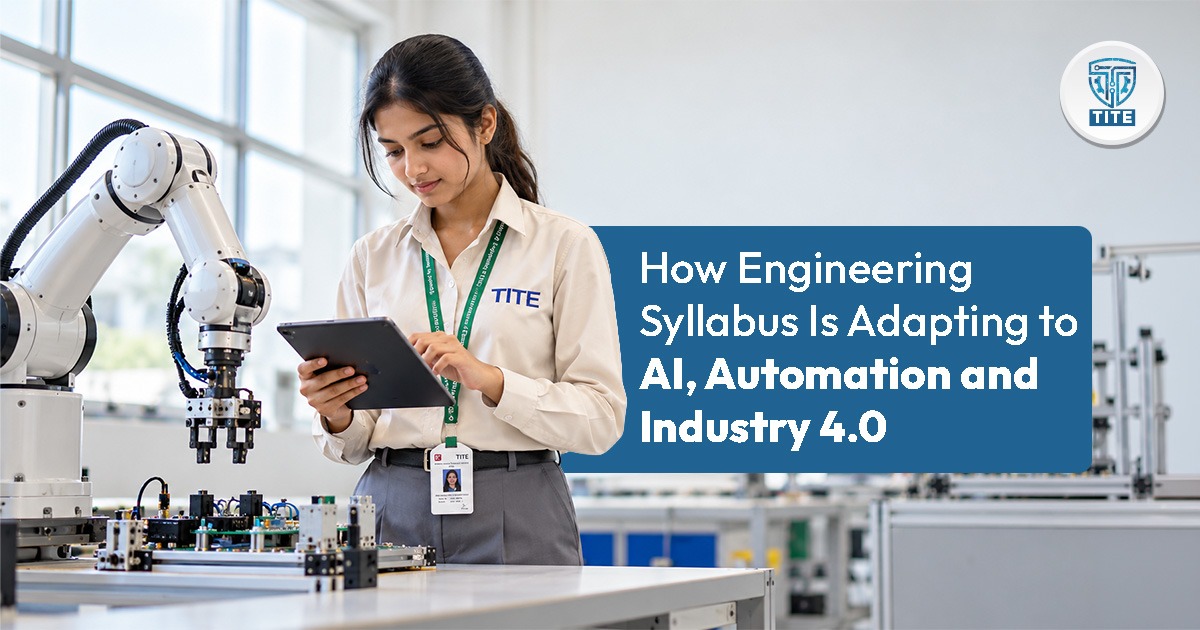
How Engineering Syllabus Is Adapting to AI, Automation and Industry 4.0
Engineering education is changing because engineering work itself is changing.
AI is entering design and analysis. Automation is reshaping manufacturing. Sensors are becoming part of infrastructure. Electrical systems are getting smarter, and software is increasingly connected with machines, devices and physical systems.
The World Economic Forum’s Future of Jobs Report 2025 estimates that 39% of key workplace skills will change by 2030. AI and big data, networks and cybersecurity, and technological literacy are among the fastest-growing skills.
For students choosing an engineering programme now, the question is no longer simply whether the syllabus includes AI or robotics. The more important question is how these technologies are being built into core engineering learning.
Engineering Subjects Are Becoming More Connected
Engineering branches still have their own foundations, but the boundaries between them are becoming less rigid.
Mechanical students may work with robotics and automation. Electrical Engineering increasingly connects with intelligent control and renewable systems. ECE overlaps with IoT, embedded intelligence and communication technologies, while Civil Engineering is beginning to use sensors, digital modelling and automated inspection.
CSE remains at the centre of AI and software, but even there, the curriculum is moving beyond conventional programming towards data, machine learning, cloud systems and cybersecurity.
The shift is therefore not from “old engineering” to “new engineering”. It is a shift from isolated subjects to more connected technical systems.
What Is Actually Changing in Engineering Education in 2026?
The change is now visible at the curriculum-policy level, not just in college marketing.
In August 2026, the Ministry of Education confirmed that AICTE had revised its Model Curricula with industry input to integrate Artificial Intelligence, Data Science, Machine Learning, Cyber Security, Robotics and Quantum Computing across technical disciplines. Read the Ministry of Education update.
That matters because emerging technology is no longer being treated only as a specialist CSE topic.
A Mechanical student may encounter automation and robotics. An Electrical student may work with intelligent control. ECE increasingly connects with embedded systems and AI, while Civil Engineering can use automation, sensing and data-led monitoring.
This is a much larger curriculum change than simply adding another elective called “Artificial Intelligence”.
AI Is Becoming a Tool Across Engineering Branches
AI has its strongest academic base in Computer Science, but its applications now extend much further.
In Mechanical Engineering, AI can support predictive maintenance and manufacturing optimisation. In Electrical Engineering, it can assist intelligent control and energy management. ECE students may work with embedded AI, computer vision or intelligent communication systems.
Civil Engineering is changing too. AICTE’s model curriculum includes areas such as robotics in construction, automated inspection and AI-linked engineering applications.
For students, the distinction is important. You do not necessarily need to become an AI engineer to work with AI. You may become a Civil, Mechanical or Electrical engineer who knows how to apply intelligent tools within that field.
Automation Is Moving Into Mainstream Engineering
Automation used to be associated mainly with large manufacturing plants. Today it appears across production, logistics, electrical systems, electronics, mobility and even construction.
Engineering students may now encounter:
- Robotics
- Sensors and actuators
- Industrial automation
- Embedded systems
- Machine vision
- Simulation
- Smart manufacturing
- Automated control
What matters is not simply seeing these terms in a syllabus. Students need enough practical exposure to understand how the systems behave.
That could mean programming a controller, working with sensors, testing a robotic setup or using simulation to understand how a design performs before it is physically built.
Industry 4.0 Is Changing How Engineers Solve Problems
Industry 4.0 brings machines, software, sensors and data into the same working environment.
Consider a modern factory.
A machine produces the component. Sensors monitor its performance. Software collects the data. An automated system adjusts the process, while an AI model may identify patterns that indicate an upcoming failure.
That single environment can involve Mechanical Engineering, Electrical Engineering, ECE and Computer Science.
Engineering education therefore needs to prepare students to understand their own branch while also seeing how it fits into a larger system.
How Different Engineering Areas Are Evolving
| Engineering Area | Traditional Foundation | What Is Being Added |
|---|---|---|
| Computer Science | Programming, algorithms, databases | AI, ML, Data Science, Cloud, Cybersecurity |
| Mechanical | Design, manufacturing, thermal systems | Robotics, automation, simulation, smart manufacturing |
| Electrical | Machines, power and control | Smart grids, renewable integration, intelligent control |
| ECE | Circuits, communication, signal processing | IoT, embedded systems, VLSI, AI-enabled devices |
| Civil | Structures, construction, geotechnical engineering | Sensors, UAVs, automated inspection, digital modelling |
The important part is the third column. New technologies are being added on top of the fundamentals, not in place of them.
Students still need to understand circuits before working with intelligent electronics. Robotics makes more sense when the student already understands mechanics and control. AI applications are stronger when backed by mathematics, programming and data fundamentals.
Practical Learning Is Becoming More Important
AI, automation and Industry 4.0 are difficult to learn through lectures alone.
Students need opportunities to test ideas, make mistakes and understand what happens when theory meets an actual system.
That makes laboratories, projects and internships increasingly important.
A student may understand machine learning in theory but learn far more after working with imperfect real-world data. Similarly, automation becomes easier to understand after programming a controller or connecting sensors to a working system.
This is why students should look beyond the syllabus document and ask what they will actually get to build, test, simulate and analyse.
Modern Engineering Is Also Becoming More Data-Driven
Data is becoming part of engineering even outside Computer Science.
Manufacturing equipment produces performance data. Smart electrical systems generate information about energy use. Sensors can track structural movement, while embedded devices constantly generate operational data.
Engineers increasingly need to interpret that information.
This does not mean every engineering student needs advanced Data Science. It does mean that programming awareness, data interpretation and analytical thinking are becoming more relevant across branches.
The World Economic Forum also places analytical thinking among important skills while identifying AI, big data and technological literacy among the areas growing fastest in importance.
How Can Students Check Whether a Syllabus Is Really Current?
Words such as AI, robotics and Industry 4.0 can make a programme sound modern. Students should still check the actual curriculum.
Look at where those topics appear and what comes before them.
A good curriculum should have:
- Strong mathematics and engineering fundamentals
- Core branch subjects
- Relevant emerging technologies
- Laboratory work
- Projects
- Electives for deeper learning
- Industry or internship exposure
For students looking at BPUT-affiliated colleges, the official BPUT syllabus page is a useful place to check how programmes are structured. BPUT currently lists revised B.Tech curricula for several recent admission batches, including updated CSE and allied-branch syllabi.
That is more meaningful than relying only on phrases such as “future-ready curriculum”.
What Should Students Look for Beyond the Syllabus?
A syllabus shows what is prescribed. It does not tell you how well the subject is taught.
Students should also check whether the college provides practical environments where those subjects can be applied.
Useful indicators include:
- Relevant laboratories
- Project-based learning
- Technical software and simulation tools
- Internships
- Hackathons
- Industry interaction
- Opportunities to work across disciplines
At TITE, the B.Tech programmes include core branches such as CSE, Electrical, ECE, Mechanical and Civil Engineering alongside newer computing options such as CSE in AI & ML and Data Science.
That mix is relevant because future-ready engineering education is not only about creating new course names. It is also about bringing emerging technology into the wider engineering learning environment.
AI Specialisation Still Needs Strong Computer Science Fundamentals
Specialised programmes can give students a deeper route into emerging technologies, but the foundation still matters.
For example, TITE’s B.Tech CSE in AI & ML combines programming, data structures, databases and networks with exposure to Machine Learning, Deep Learning, Data Science, Computer Vision and related tools.
That progression matters.
Students need programming before advanced AI development. They need statistics and data handling before machine learning becomes meaningful. A good specialisation should therefore deepen the core branch rather than replace it.
What Will Matter Most for Engineering Students?
Technology will continue to change during a four-year degree.
The exact software or platform students use in the first semester may not be the one they use when they graduate.
That is why a future-ready curriculum needs to develop abilities that travel across technologies:
- Analytical thinking
- Problem-solving
- Programming awareness
- Data interpretation
- Systems thinking
- Technical communication
- Adaptability
- Continuous learning
Students still need branch-specific expertise. But they also need enough flexibility to work with technologies that may not yet be standard when they begin college.
What Should You Compare Before Choosing an Engineering College?
Students often compare placements, fees and campus infrastructure first. The curriculum deserves the same attention.
Before choosing, check:
- What you study in each semester
- How strong the core branch subjects are
- Where AI and automation appear
- What laboratories support them
- Whether projects begin early enough
- What industry exposure students receive
- Whether specialised electives are available
The presence of an AI lab or an Industry 4.0 subject is not enough on its own. The stronger programme is the one where new technology connects naturally with engineering fundamentals and practical work.
Engineering Education Is Changing, Not Starting Again
AI and automation are not making traditional engineering obsolete.
They are changing what engineers can do with it.
Mechanical principles still matter in robotics. Circuit fundamentals remain essential in intelligent electronics. Structural engineering is still necessary when AI is used to analyse infrastructure. Mathematics and programming remain central to machine learning.
The engineering syllabus of the future will therefore need both sides: strong fundamentals and meaningful exposure to the technologies changing how those fundamentals are applied.
For students considering engineering at TITE, that is the better way to compare programmes. Look beyond how modern a course sounds and examine how well the curriculum prepares you to understand, use and adapt to the technology shaping engineering work.
Frequently Asked Questions
1. How is AI changing engineering syllabus?
AI is increasingly being introduced through automation, data analysis, intelligent systems and branch-specific applications.
2. What is Industry 4.0 in engineering?
It refers to connected industrial systems that combine automation, sensors, IoT, software and data.
3. Is AI relevant only for CSE students?
No. AI applications are also growing in Mechanical, Electrical, ECE, Civil and other engineering fields.
4. What should students check in a modern engineering syllabus?
Check core subjects, emerging technologies, laboratories, projects, electives and practical exposure.
5. Are engineering fundamentals still important?
Yes. AI, automation and smart systems depend on strong mathematics, programming and core engineering knowledge.
