
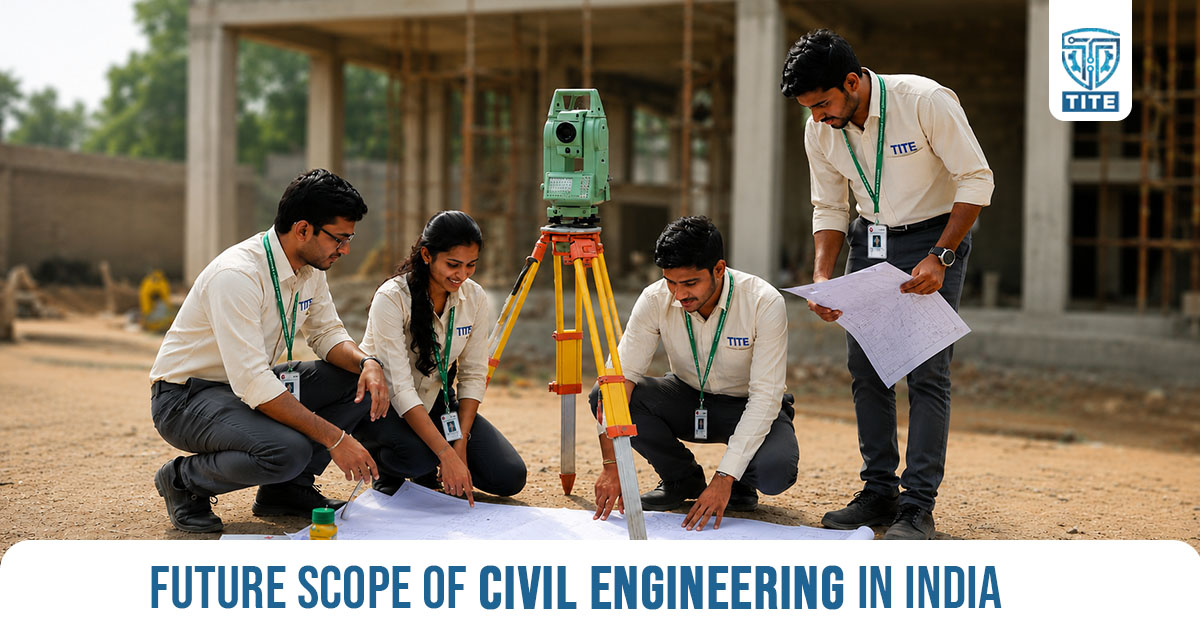
Future Scope of Civil Engineering in India
Summary: India is transforming at an unprecedented pace. Smart cities, sustainable infrastructure, high-speed transportation, renewable energy projects and urban expansion are creating a massive demand for skilled civil engineers. This article explores the future scope of Civil Engineering in India through the eyes of aspiring students, highlighting emerging opportunities, technological advancements, government initiatives and the role of quality education in shaping tomorrow’s infrastructure leaders.
Imagine standing on a busy city flyover during the evening rush. Thousands of vehicles move seamlessly below. A metro train glides across an elevated track. In the distance, a new residential township is taking shape, while a modern hospital rises from what was once an empty plot of land.
Have you ever wondered who turns these massive visions into reality? The answer is civil engineers.
For many students exploring career options after school, Civil Engineering often appears as a traditional branch. However, the reality is very different. Today's civil engineers are designing smart cities, creating sustainable infrastructure, developing earthquake-resistant structures and integrating advanced technologies into construction projects.
As India moves toward becoming a global economic powerhouse, the demand for skilled civil engineers is growing rapidly. Students searching for quality education in Civil Engineering Colleges in Bhubaneswar are increasingly recognizing the enormous opportunities that lie ahead.
Institutions like TITE are preparing future engineers to contribute to India's infrastructure revolution through industry-focused learning and practical exposure. According to the Ministry of Housing and Urban Affairs, India's urban population is expected to continue growing significantly, creating an unprecedented demand for infrastructure development and modernization. This means one thing civil engineers will remain at the heart of India's progress.
India's Infrastructure Boom: A Golden Era for Civil Engineers
Let's imagine the year 2035. A student graduating today as a civil engineer could be working on a smart city project, designing sustainable housing, managing a high-speed rail corridor or leading a renewable energy infrastructure initiative.
India's infrastructure sector is witnessing historic investments. Major government initiatives such as Smart Cities Mission, Bharatmala, Sagarmala, PM Gati Shakti and large-scale urban redevelopment projects are creating countless opportunities for civil engineering professionals.
This growing demand has encouraged many students to explore civil engineering colleges in Odisha that offer practical training and industry-oriented education. The future isn't just about constructing buildings anymore. It is about building intelligent, efficient and sustainable environments where people can live, work and thrive.
The Rise of Smart Cities
Think about a city where traffic lights communicate with vehicles, water systems detect leaks automatically and public transportation runs with maximum efficiency.
These are not science fiction concepts.
India's Smart Cities Mission is transforming urban infrastructure across the country. Civil engineers play a critical role in planning, designing and executing these projects.
From road networks and drainage systems to energy-efficient buildings and digital infrastructure, civil engineers are responsible for integrating technology with physical infrastructure.
Students pursuing education from leading B Tech civil engineering colleges are increasingly learning concepts related to smart infrastructure, data-driven planning, and sustainable urban development. The future civil engineer will not just work with concrete and steel. They will also work with data, automation and intelligent systems.
Sustainable Construction: The Future of Development
A few decades ago, infrastructure development focused primarily on functionality. Today, sustainability has become equally important. Modern construction projects are expected to minimize environmental impact while maximizing efficiency.
Green buildings, energy-efficient designs, rainwater harvesting systems, waste management infrastructure and eco-friendly construction materials are becoming industry standards. Organizations such as the Indian Green Building Council actively promote sustainable construction practices across India.
This shift has created new career opportunities for graduates from Civil Engineering Colleges in Bhubaneswar who possess knowledge of sustainable engineering principles. Future civil engineers will help balance economic growth with environmental responsibility, making them key contributors to sustainable development.
Emerging Technologies Transforming Civil Engineering
Imagine a construction site where drones monitor project progress, artificial intelligence predicts structural issues and 3D printers create building components. This future is already becoming reality. Technology is revolutionizing the civil engineering industry in several ways:
- Building Information Modeling - BIM enables engineers to create digital representations of buildings and infrastructure before construction begins. It improves collaboration, reduces errors, and enhances project efficiency.
- Artificial Intelligence and Machine Learning - AI helps predict maintenance requirements, optimize designs, and improve project planning.
- Drones and Remote Monitoring - Construction companies increasingly use drones for surveying, mapping, inspection and progress tracking.
- 3D Printing in Construction - Innovative construction techniques are reducing costs and accelerating project timelines.
Expanding Career Opportunities
One of the biggest misconceptions among students is that civil engineering careers are limited to construction sites. In reality, the field offers diverse career paths.
- Structural Engineering - Designing safe and durable buildings, bridges, dams, and industrial facilities.
- Transportation Engineering - Developing highways, railways, airports, and urban transit systems.
- Environmental Engineering - Managing water resources, pollution control, and sustainable infrastructure.
- Geotechnical Engineering - Studying soil behavior and foundation systems for construction projects.
- Construction Management - Leading large-scale projects, managing teams, budgets, and timelines.
- Urban Planning - Designing future-ready cities and communities.
Government Projects Driving Employment
India's infrastructure pipeline is generating substantial employment opportunities.
Projects involving highways, metro rail systems, airports, industrial corridors, renewable energy parks and urban redevelopment require thousands of skilled engineers.
The National Infrastructure Pipeline (NIP) and PM Gati Shakti initiative continue to accelerate infrastructure investments across the country. For students pursuing degrees from recognized civil engineering colleges in Bhubaneswar, these projects represent long-term career opportunities with strong growth potential. As infrastructure development expands, the demand for technically competent civil engineers is expected to remain strong for decades.
Global Opportunities for Civil Engineers
Civil Engineering is not limited by geographical boundaries. Indian civil engineers are highly respected worldwide due to their technical expertise and project management capabilities. Countries across the Middle East, Europe, North America, Southeast Asia, and Australia continue to recruit skilled civil engineering professionals.
Large multinational infrastructure companies seek engineers capable of working on complex international projects. Students graduating from quality civil engineering colleges in Odisha often pursue global careers after gaining experience and specialized certifications. This international demand further enhances the long-term value of a civil engineering degree.
Why Choosing the Right College Matters
Imagine two students graduating with the same degree. One has only theoretical knowledge. The other has participated in live projects, industry internships, practical training, software workshops, and research activities.
Who will have better career prospects? The answer is obvious. The future scope of Civil Engineering depends not only on industry demand but also on the quality of education students receive. Choosing institutions that emphasize practical learning, technological exposure, industry interaction and skill development can significantly influence career outcomes.
Building India's Future Starts with You
Every bridge that connects communities, every highway that drives economic growth, every metro that transforms urban mobility and every sustainable building that protects our environment begins with a vision.
vision belongs to civil engineers. The future scope of Civil Engineering in India is brighter than ever. As the nation continues its journey toward modernization, digital transformation and sustainable development, civil engineers will remain among the most important contributors to national progress.
For students who dream of creating structures that stand for generations, solving real-world challenges and leaving a lasting impact on society, Civil Engineering offers a career filled with purpose, innovation, and opportunity.
If you're ready to become part of India's infrastructure revolution, explore the opportunities available through the admission process at TITE. The journey from classroom concepts to shaping skylines begins with the right education, the right guidance and the determination to build a better tomorrow.
The next great bridge, smart city, sustainable township or engineering marvel may not just be something you admire, it could be something you create.
