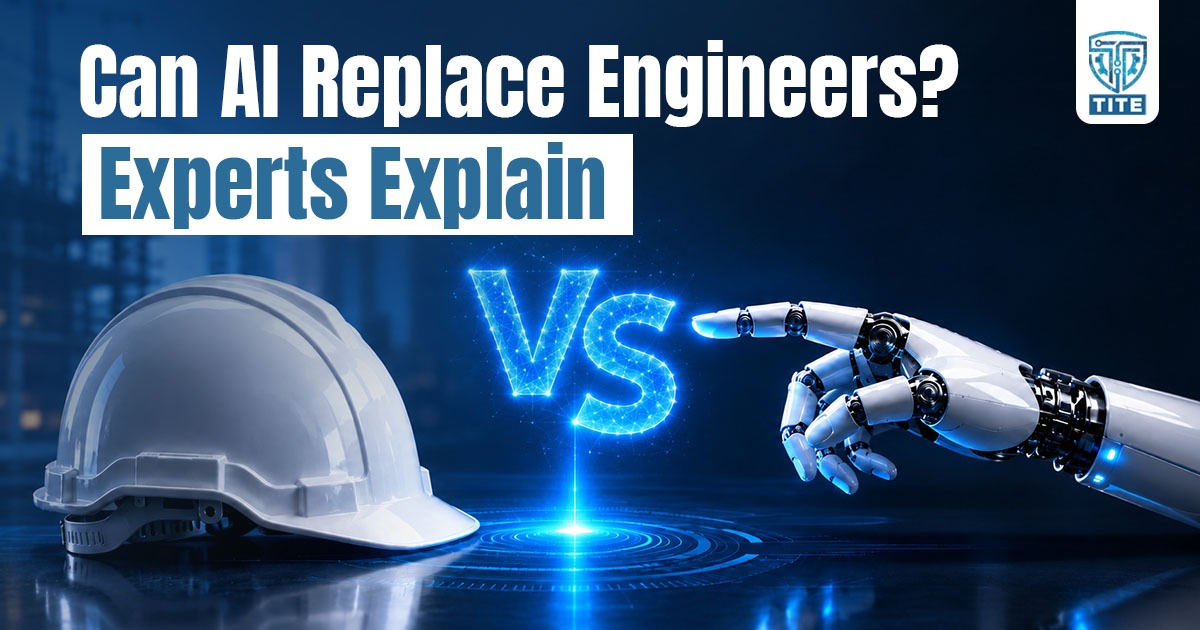
Can AI Replace Engineers? Experts Explain
The rapid rise of generative artificial intelligence, high-level LLMs and automated design generators has sparked widespread anxiety across modern technical sectors. Many industry professionals worry that routine coding, CAD modeling and system testing will soon render human technical roles completely obsolete. However, AI engineering college in Odisha are actively reshaping their curricula around this shift, teaching students that artificial intelligence is ultimately an empowering force multiplier rather than an immediate replacement for core human talent.
Rather than signaling an end to the profession, automated systems represent the next major leap forward in workflow evolution. Technical programs, such as those offered at TITE, emphasize bridging foundational engineering principles with intelligent automation tools. By taking over repetitive tasks, boilerplate coding and routine data analysis, smart systems allow engineers to offload monotonous workloads. This transition frees up professionals to focus on high-level strategy, complex system integrations, creative design solutions and cross-functional project management.
Real-world statistics support this collaborative outlook rather than a total takeover. According to global workforce data from the U.S. Bureau of Labor Statistics, software developer and engineering roles are projected to grow much faster than average through 2033 despite expanding automation. While AI excels at rapid computation and pattern recognition, it lacks critical domain context, intuitive problem-solving abilities and safety accountability. Consequently, expert consensus remains firm - while smart tools will handle baseline execution, human judgment and ethical stewardship make engineers indispensable.
Also Read: Computer Science vs AI & ML Engineering: Which Is Better?
What AI Does Well: The Automation of Routine Engineering
The rapid integration of artificial intelligence is fundamentally shifting how engineering teams approach baseline technical work. By absorbing time-consuming execution tasks, intelligent platforms allow engineers to transition away from manual overhead toward higher-value system architecture and design.
Speeding Up Iteration
Artificial intelligence drastically accelerates product development by automating time-consuming design phases. Modern AI tools generate functional boilerplate code, automate complex unit testing and instantly create design iterations. In physical engineering, integrated generative platforms run real-time CAD and CAE simulations, allowing teams to test thousands of structural parameters in minutes without manual rebuilds.
Data Synthesis & Optimization
Machine learning excels at processing massive datasets to identify complex engineering patterns. Algorithms analyze operational logs to predict component failures, optimize thermal and stress models for hardware, and suggest efficient software microservice structures. According to Autodesk's generative design analysis, AI evaluates physical loads and material constraints to uncover lighter, stronger configurations human designers might miss.
The Shift in Workload
These advances are fundamental in changing how technical teams allocate their time. Engineers no longer need to spend hours executing repetitive manual calculations, line-by-line debugging or routine CAD cleanup. By shifting baseline execution to intelligent systems, engineers can pivot toward higher-level problem solving, architecture design, system validation and long-term project strategy.
Also Read: Best Engineering College for AI & ML in Odisha
Why AI Cannot Replace Engineers: The Expert Consensus
While artificial intelligence continues to automate baseline technical work, industry leaders and academic experts agree that engineering is inherently more than code syntax or CAD generation. True engineering relies on critical thinking, accountability, and real-world execution—capacities where algorithmic models consistently fall short.
Leading educational institutions, such as top AI BTech engineering colleges in Odisha and specialized robotics engineering colleges in Odisha, are restructuring their programs to emphasize these non-automatable human skills over basic execution.
Context, Semantics, and Lived Judgment
Current AI models operate on pattern recognition rather than genuine comprehension. They lack an understanding of dynamic program semantics, physical material decay, and broader real-world domain contexts.
- The Reality of Trade-Offs: Engineering decisions rarely have a single mathematically "correct" answer. Every project involves balancing technical debt, strict financial budgets, legacy infrastructure, and team capacity.
- The Expert Take: AI can analyze historic data to suggest an idealized pattern, but it cannot evaluate whether that pattern is practical under an aggressive launch schedule, constrained supply chains, or evolving business goals. Human engineers provide the strategic context needed to make pragmatic compromises.
The "Almost Right" Paradox & Quality Control
Generative platforms frequently produce output that appears 80% to 90% accurate on the surface. However, in mission-critical applications, that remaining 10% to 20% gap represents a severe vulnerability.
- The Edge-Case Problem: AI often hallucinates details, miss boundary conditions, or introduce subtle security defects when handling novel edge cases.
- The Need for Oversight: Resolving these flawed outputs often requires more deep-level troubleshooting than writing the initial architecture manually. Human review, rigorous verification, and architectural oversight are far more essential now to prevent poor quality code or flawed structural designs from reaching production.
Accountability, Safety, and Ethics
Engineering is a licensed profession tied directly to public safety and strict legal standards. An algorithm cannot sign off on a structural blueprint or accept legal responsibility when systems fail.
- Moral and Legal Ownership: If an autonomous vehicle crashes, a medical device miscalibrates, or a bridge collapses, an algorithm cannot be held legally or ethically accountable.
- Defining "What Ought to Be Built": AI excels at computing answers to explicit prompts, but only human engineers can determine what should be built. Humans must establish safety boundaries, evaluate long-term environmental impacts, and enforce data privacy standards.
Cross-Functional Translation & Empathy
Engineering extends beyond isolated technical problems to serve human users and organizations. Translating abstract human needs into strict technical parameters requires deep social intelligence and emotional awareness.
- Managing Stakeholders: Engineers routinely interface with non-technical clients, product managers, and executive leadership to reconcile conflicting demands, clarify ambiguous requirements, and align project scope.
- Designing with Empathy: A system can be technically functional yet fail completely if it ignores human ergonomics, accessibility, or practical user workflows. Navigating cross-functional dynamics, understanding client anxiety, and applying human empathy remain entirely beyond the scope of AI models.
How the Engineering Role Is Evolving
Rather than replacing human technical professionals, artificial intelligence is transforming engineers from transactional coders and draftspeople into strategic system orchestrators. To keep pace with this shift, leading institutions among top engineering colleges are overhauling their curricula to emphasize holistic architectural design, prompt engineering, and critical system verification alongside core foundational principles.
| Historical Engineering Focus | The AI-Augmented Engineer |
|---|---|
| Manual Execution: Writing boilerplate code, manual drafting, and calculating routine equations line by line. | System Architecture: Defining macro-level system logic, prompt engineering, and structuring scalable digital pipelines. |
| Tool-Heavy Operations: Spending days mastering syntax, CAD tool mechanics, or manual unit testing. | Strategic Verification: Evaluating automated outputs, edge-case safety, and domain-specific trade-offs. |
| Siloed Contributions: Working as an isolated individual contributor handling low-level component design. | Hybrid Team Orchestration: Directing AI agents, coordinating cross-functional business stakeholders, and managing product lifecycles. |
Crucial Skills for the Next Generation of Engineers
As artificial intelligence absorbs routine execution, technical proficiency alone is no longer enough to guarantee a successful career. Modern engineers must evolve from tactical creators into strategic system designers, code auditors, and ethical decision-makers. Leading technical institutions - including top private B Tech colleges in Odisha are recalibrating their learning models to help students build high-value competencies that algorithms cannot emulate.
- Macro-System & Architectural Design: Modern engineers must focus on high-level system components, scalability parameters, and integration blueprints. Rather than writing isolated functions, the next generation will concentrate on structuring resilient digital architectures, microservice boundaries, and end-to-end platform stability.
- AI Tool Orchestration & Prompting: Fluency in AI-driven tools is fast becoming a core job requirement. Engineers must learn how to direct generative platforms using precise prompts, integrate machine learning APIs into existing software infrastructure, and leverage automated tools for rapid prototyping.
- Legacy Management & Code Auditing: With AI tools flooding codebases with auto-generated functions, the ability to read, refactor, and debug complex legacy systems is critical. Future engineers will spend significant time auditing AI outputs, fixing subtle edge-case errors, and optimizing code for efficiency and security.
- Cross-Disciplinary Strategy & Communication: Bridging the gap between technical execution and business goals requires strong human interaction. Engineers must possess the communication skills needed to negotiate project requirements, explain trade-offs to non-technical leaders, and build user-centric solutions.
Related Article: Skills Every Engineering Student Should Learn Before Graduation
The ultimate takeaway from industry experts and modern educators is clear: artificial intelligence will not replace engineers. Instead, engineers who harness the power of AI tools will inevitably replace those who do not. While machine learning algorithms excel at accelerating calculations, automating routine code and evaluating complex data patterns, they lack the real-world context, strategic judgment and ethical stewardship required to lead modern technical projects. Engineering remains a deeply human enterprise rooted in accountability, problem-solving and continuous innovation.
To thrive in this evolving landscape, prospective students must choose academic programs that balance foundational engineering with cutting-edge technical innovation. Recognizing a best bput engineering college involves looking for institutions that actively upgrade their infrastructure and emphasize hands-on AI integration alongside core human engineering principles.
Ready to build a career at the intersection of traditional engineering and intelligent automation? Explore how TITE's Admission Portal can guide your journey toward becoming an AI-augmented technical leader.
