Your Future Is in Your Hands — Don't Ditch It, Build It
Event Background
An induction programme marks the beginning of an important new chapter for students. Beyond introducing them to a new academic environment, it creates an opportunity to help them understand the mindset, values and approach that can shape their years ahead. The TITE Induction Programme brought our students together for such an engaging learning experience, with distinguished academic and scientific voices offering perspectives beyond conventional classroom education.

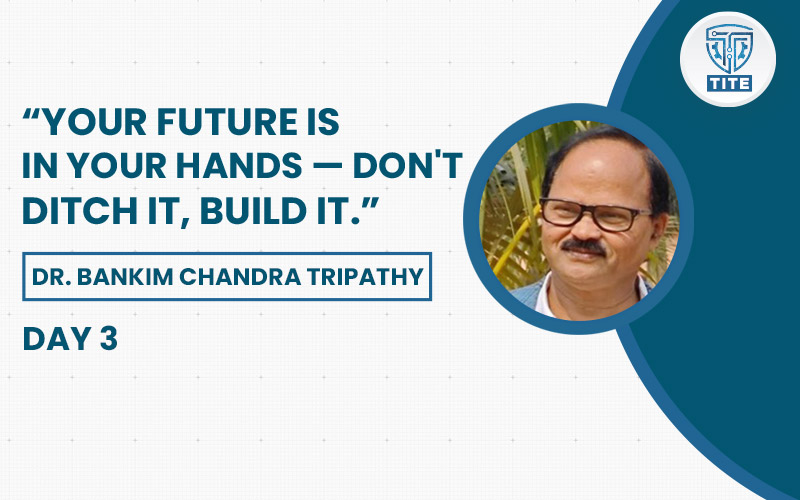
Among the notable interactions was that of Dr. Bankim Chandra Tripathy, Chief Scientist at CSIR-Institute of Minerals and Materials Technology (CSIR-IMMT), Bhubaneswar, and Professor of Chemical Sciences at the Academy of Scientific and Innovative Research (AcSIR). His professional journey and research experience offered our students valuable insights into taking ownership of their growth and transforming knowledge into meaningful outcomes.
About Dr. Bankim Chandra Tripathy/Author’s Bio
Dr. Bankim Chandra Tripathy is a Chief Scientist in the Hydro, Bio & Electrometallurgy Department at CSIR-IMMT and a Professor in the Faculty of Chemical Sciences, AcSIR. He completed his M.Sc. in Chemistry from Utkal University in 1992 and earned his Ph.D. in 2000.
With more than 25 years of research and development experience, Dr. Tripathy has worked extensively across extractive metallurgy, hydrometallurgy, electrometallurgy, waste recycling, resource recovery and sustainable management of industrial wastes. His research has taken him across India and international institutions in countries including Australia, Canada, Mexico and South Africa.
His contribution to scientific research includes more than 160 research publications, five national and two international patents, and the guidance of numerous doctoral and postdoctoral researchers. His work on hazardous waste aluminium dross earned him the NRDC National Meritorious Invention Award 2019 under the National Societal Innovation Award category.
Building, Rather Than Waiting for the Future
Drawing from his extensive experience in science, research and innovation, Dr. Tripathy's interaction encouraged our students to think about their future as something they actively shape rather than passively wait for.
He highlighted that his own career demonstrates how academic knowledge can evolve into research, innovation, and solutions with societal relevance. This added a valuable perspective for our students at the beginning of their higher education journey, reminding them that their time in college is an opportunity to develop not only technical knowledge but also the ability to identify problems, think independently, and create solutions.
The central thought behind his message was reflected in the powerful line, “Your Future Is in Your Hands — Don't Ditch It, Build It.” The message carries a simple but significant responsibility: the choices they make, the skills they develop, and the effort they invest today influence the opportunities they create tomorrow.
Turning Knowledge into Meaningful Solutions
Dr. Tripathy's research journey also offered our students an important perspective on the purpose of innovation. His work in waste recycling, resource recovery, and circular economy demonstrates how scientific research can address some of society's pressing environmental and industrial challenges.
Through this lens, our students begin to see technology not merely as a collection of concepts and applications, but as a means of responding to real-world needs. His experience encourages our young learners to look at challenges differently—to ask how existing resources can be used more effectively, how waste can become a valuable resource, and how innovation can contribute to a more sustainable future.
He further highlighted the importance of remaining open to new ideas, perspectives and partnerships. This reinforces the value of communication, collaboration and continuous learning for students alongside technical expertise.
Inspiring Students to Take Ownership
The interaction added a meaningful dimension to the Induction Programme by encouraging our students to think beyond immediate academic goals. Dr. Tripathy's career reflects a journey where knowledge, research, and persistence have translated into innovations with wider societal impact.
He reminded that “the future is not simply something to be predicted—it is something to be built. By staying curious, developing relevant skills, embracing challenges, and using knowledge purposefully, you can gradually create a professional path that is both successful and meaningful.”
