Why Skill-based Engineering Education Matters in 2026?
As an engineering aspirant, you spend years selecting from the best engineering colleges, investing four years of learning, lakhs of rupees in tuition, and appearing for multiple exams. Yet, when placement season arrives, recruiters often ask candidates to demonstrate skills that their curriculum never taught them. This is the reality faced by many engineering graduates who hold successful degrees but struggle to secure suitable employment.
The issue is not a shortage of jobs. Rather, it is the widening gap between academic education and industry-ready skills.
Job Market for Engineers in 2026: The Great Shift
The engineering job market in 2026 looks significantly different from what it was just a few years ago. Artificial Intelligence (AI) is reshaping hiring criteria and transforming the employment landscape. According to Ernst & Young India, the adoption of Generative AI could impact nearly 38 million jobs in India by 2030 through automation, augmentation, and role transformation.
Additionally, the Future of Jobs Report 2025 suggests that approximately 69% of formal sector jobs in India—including manufacturing, IT, finance, retail, and services—could be automated by 2030. Traditional entry-level technical roles that once served as stepping stones for fresh graduates are rapidly evolving or disappearing.
Employers today prioritize adaptability, problem-solving ability, and practical expertise over academic scores alone. Degrees and grades are no longer enough. Professionals who can quickly adapt to emerging technologies, collaborate across disciplines, and solve real-world challenges are increasingly preferred over candidates with only theoretical knowledge.
At the same time, the growth of startups, Global Capability Centers (GCCs), and digital transformation initiatives across industries is creating opportunities beyond traditional IT roles. Students who combine technical expertise with communication, innovation, and adaptability are better positioned to succeed in today's competitive job market.
What Is Skill-Based Engineering Education and Why Does It Matter?
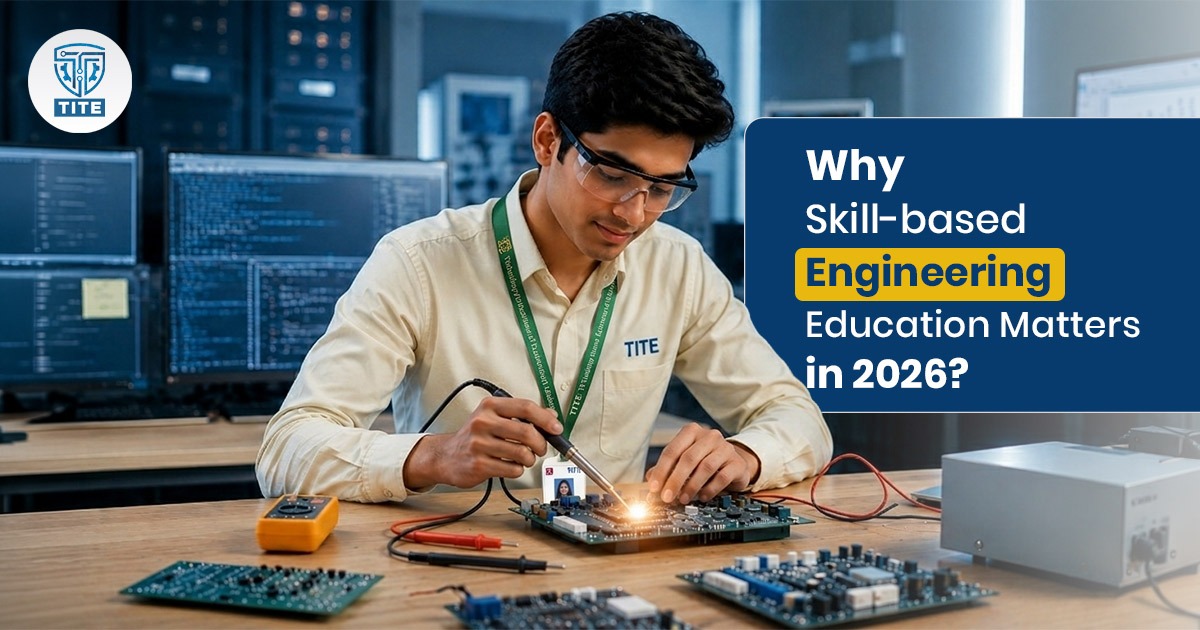
As industries evolve with new technologies, they require professionals who can understand and work efficiently with modern systems. Skill-based engineering education focuses on practical learning, hands-on experience, real-world problem-solving, industry projects, and exposure to contemporary tools and technologies.
This approach does not replace theoretical learning. Instead, it strengthens engineering education by integrating practical skills with academic concepts throughout the learning journey. Simply put, it is the difference between a student who can explain how a machine works and one who can actually build and operate it.
As companies increasingly expect graduates to contribute from day one, skill-based education plays a critical role in preparing students with competencies that employers actively seek. Leading engineering institutions are responding by combining academic instruction with hands-on career training from the beginning of a student's educational journey.
Exposure to industry challenges during college also boosts confidence, employability, and workplace readiness. In a highly competitive hiring environment, graduates with practical experience often gain a distinct advantage during placements and career opportunities.
Recognizing the growing employability gap, forward-thinking engineering colleges are redesigning their curricula to emphasize project-based learning. Students are encouraged to solve industry-relevant problems from their first year onward, effectively bridging the gap between classroom learning and professional careers.
This approach aligns closely with the vision of India's National Education Policy (NEP) 2020, which advocates for producing graduates who are analytically strong, practically capable, and employment-ready.
Top Skills That Matter in 2026
For aspiring engineers and parents planning a future in engineering education, the following skills are among the most valuable in 2026:
1. Artificial Intelligence & Machine Learning
AI and ML skills enable engineers to develop intelligent systems capable of analyzing data, automating processes, and improving decision-making.
2. Programming & Data Fluency
Not every engineer needs to become a software developer, but familiarity with programming and data analysis is increasingly essential. These skills help professionals transform complex data into actionable business and engineering insights.
3. Cloud Computing
Cloud technology now extends far beyond software development. Engineering workflows in manufacturing, healthcare, and infrastructure are increasingly cloud-based, making familiarity with platforms such as AWS, Microsoft Azure, and Google Cloud highly valuable.
4. Problem-Solving & Critical Thinking
Employers value engineers who can identify challenges, evaluate alternatives, and create innovative solutions to real-world problems.
5. Communication & Team Collaboration
Strong communication and collaboration skills enable professionals to work effectively within teams, present ideas clearly, and coordinate across departments and projects.
6. Hands-On Experience with Industry Tools
Proficiency in tools such as AutoCAD, SolidWorks, MATLAB, Power BI, and cloud platforms has become increasingly important. Employers expect graduates to possess familiarity with industry-standard tools before joining the workforce.
How TITE Prepares Graduates for Employment
The TempleCity Institute of Technology and Engineering (TITE) is among the leading engineering colleges in Bhubaneswar, dedicated to nurturing future innovators, leaders, and problem-solvers.
TITE distinguishes itself through an industry-oriented curriculum, experiential learning opportunities, strong industry partnerships, innovation-driven initiatives, interdisciplinary collaboration, and a thriving entrepreneurial ecosystem.
From the very first semester, students are encouraged not only to understand engineering concepts but also to apply them. Advanced laboratory facilities, industry internships, and exposure to current industry practices help students develop both technical expertise and essential life skills.
This comprehensive approach equips graduates with the professional competence and adaptability required to succeed in a rapidly evolving workplace.
The Bottom Line
The future of engineering belongs to individuals who can effectively apply their knowledge to solve practical challenges. In 2026, the gap between traditional engineering curricula and industry expectations has become more apparent than ever.
Skill-based engineering education is no longer optional—it is essential for both individual career success and national economic growth. Therefore, aspiring engineers should choose their institutions carefully.
The key consideration should not simply be the reputation or recognition of a college, but the adaptability and industry relevance of its curriculum. The right institution will empower students with the skills, mindset, and practical experience required to thrive in the future workforce.
Because in 2026, a degree may open the door—but skills drive the career.
