
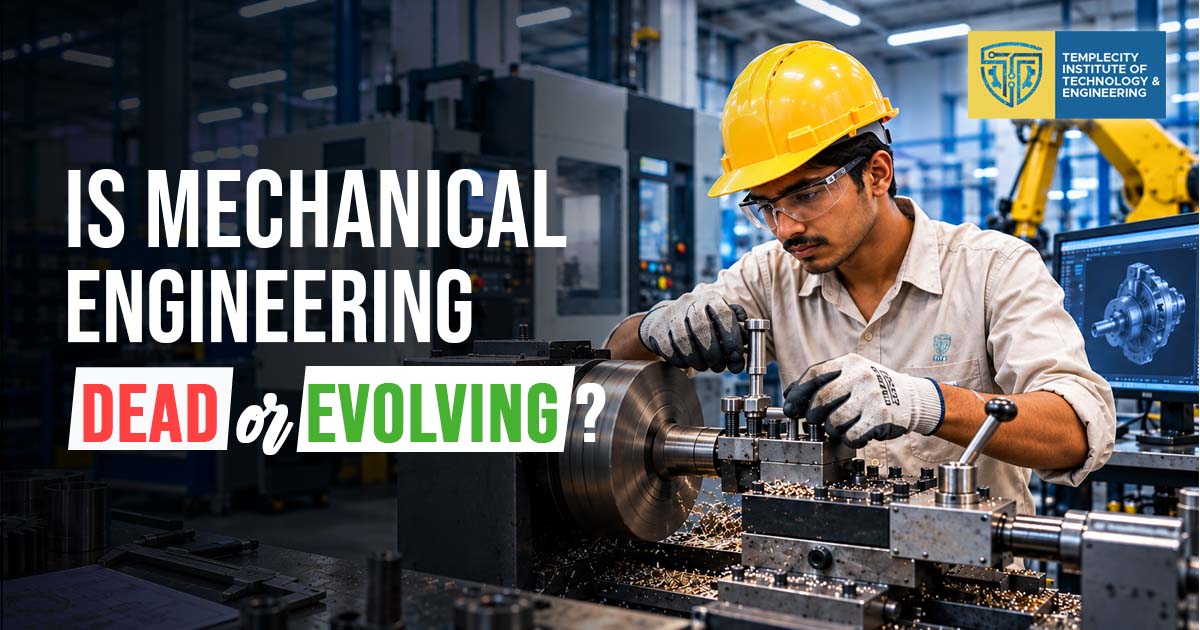
Is Mechanical Engineering dead or evolving?
A widespread myth claims software is rendering physical engineering obsolete, leading many to wrongly question the field's future. Yet, real-world hardware demands continue to surge dramatically across industrial ecosystems. As modern industries integrate advanced tech, top mtech mechanical engineering colleges in Bhubaneswar are actively updating their curricula to meet this shift. Far from dying, the discipline is shedding its outdated image and rebuilding itself around smart, interconnected physical systems.
This transformation is completely reshaping traditional perceptions, which long invoked images of grease-covered wrenches, manual draft boards and isolated CAD models. Modern engineering has evolved into an interconnected landscape driven by IoT sensors, advanced thermal management and dynamic digital twins. Forward-thinking institutions such as TITE are aligning their academic training directly with these industry shifts. Hardware design no longer happens in a vacuum; it now operates in constant sync with real-time software analytics.
Ultimately, this seamless integration marks the field's biggest evolutionary leap since the Industrial Revolution. Engineers are moving past static modeling toward AI-driven generative design and smart robotics, where software enhances physical performance rather than replacing it. Generative algorithms now draft complex geometries, leaving engineers to optimize for structural integrity and real-world execution. Mechanical engineering is not facing extinction, it is redefining how we build the physical world.
Real-World Pioneers Driving the Mechanical Engineering Evolution
At Tesla, the traditional distinction between structural frame design and battery engineering has completely blurred. Rather than placing a heavy battery pack inside an existing car chassis, Tesla engineers redesigned the 4680 battery cells to act as a direct structural element linking the front and rear body castings. This mechanical integration reduces vehicle weight, decreases part counts, and increases torsional rigidity, proving that modern mechanical engineering relies as much on smart structural synthesis as it does on raw material science.
Robotics powerhouse Boston Dynamics relies on advanced mechanical innovation to make dynamic physical movement possible. Their humanoid and quadrupeds, such as Spot and Stretch, combine custom hydraulic systems, lightweight high-strength alloys, and integrated actuators that respond instantly to complex terrains. Designing these platforms requires mechanical engineers to master thermal heat dissipation, gear ratios, and dynamic load distribution, working hand-in-hand with software control loops to replicate natural, fluid movement.
Meanwhile, global technology leader Siemens is redefining manufacturing through its comprehensive digital twin technology. Before a physical gas turbine or production line is built, mechanical engineers run complex multiphysics simulations using virtual replicas to predict stress points, fluid dynamics, and wear over time. By bridging real-time sensor telemetry with physical modeling, Siemens enables engineers to optimize machine performance continuously, demonstrating how software amplifies physical mechanical design rather than replacing it.
Why People Think Mechanical Engineering is "Dying"
Public perception around mechanical engineering has taken a hit, creating genuine doubt among prospective students and entry-level professionals. Understanding why this narrative exists reveals the gap between cultural myth and modern industry reality.
The Software Hype Cycle
For over a decade, computer science and tech roles dominated headline compensation packages. High-profile software engineering starting salaries overshadowed hardware engineering, leading to a widespread belief that digital products were the only path to high-growth careers. Physical infrastructure and hardware development, while essential, lacked the rapid viral scalability of consumer applications, driving capital and talent toward code over components.
Legacy Perceptions and Outdated Curricula
A primary driver of this skepticism stems from academia itself. Many traditional university programs remained anchored to legacy coursework, focusing heavily on internal combustion engines, basic metallurgy and manual drafting, while industry demands surged toward smart systems. Students searching for the best btech mechanical engineering colleges in odisha frequently cite curriculum modernization as their top concern. When degree programs fail to highlight mechatronics, thermal management for electronics or sensor integration, graduates naturally feel unprepared for modern engineering challenges.
Automation and Generative Design Anxiety
The rapid rise of AI-driven generative design and automated CAD systems has sparked fears of role displacement. Misinformed narratives suggest that software will soon generate structural designs independently, rendering mechanical draft engineers obsolete. In practice, however, these tools function as force multipliers: while algorithms generate raw geometric possibilities based on stress constraints, experienced mechanical engineers remain essential to evaluate material feasibility, manufacturing limits and physical safety dynamics.
The Shift: From Pure Hardware to Cyber-Physical Systems
The belief that B.Tech mechanical engineering is declining overlooks a massive structural change: the transition from isolated physical machinery to integrated Cyber-Physical Systems (CPS). Under the banner of Industry 4.0, physical hardware no longer functions as a standalone entity. Every modern mechanical assembly from industrial pump stations to aerospace landing gear is built as an intelligent, connected node embedded with sensors, microcontrollers and real-time data feeds.
Mechatronics & Robotics
The era of pure mechanical drafting is over; modern product development requires multi-disciplinary mechatronics. Today's engineers design complete kinetic systems where mechanical linkages, electric actuators and control software operate as a unified unit. Robotics engineers, for instance, must balance structural mass, gear ratios and heat dissipation alongside algorithm logic to ensure precise trajectory control and physical safety.
Live Digital Twins
Rather than relying on static CAD models, physical assets now exist alongside dynamic Digital Twins virtual replicas synchronized via real-time IoT telemetry. Installed on jet engines, wind farms or automated assembly plants, these software models process real-world stress, vibration and temperature data to predict fatigue and prevent component failure before it occurs.
AI & Generative Design as Force Multipliers
Artificial intelligence is not replacing mechanical engineers; it is transforming how they work. Through generative design, engineers input boundary constraints such as payload capacity, maximum mass, material limitations and production budget. Deep learning algorithms then compute hundreds of organic, highly optimized geometries that minimize weight while maximizing strength. The engineer directs the process: validating physical feasibility, selecting manufacturing methods and leading final structural verification.
Advanced Additive Manufacturing (3D Printing)
Hardware prototyping is no longer bound by conventional machining constraints. Industrial additive manufacturing allows engineers to fabricate complex internal cooling channels and lattice structures that were previously impossible to produce. This capability significantly accelerates iterative testing cycles from months down to hours.
Smart Materials & Haptics
The boundary between structures and electronics continues to blur. Modern mechanical design increasingly incorporates smart materials such as shape-memory alloys, piezoelectric sensors, and haptic feedback systems that alter their physical properties in response to environmental shifts, heat or electrical currents.
Data contradicts the misconception that mechanical engineering is slowing down. According to official reports from the U.S. Bureau of Labor Statistics, mechanical engineering employment is projected to grow 9% through 2034 substantially faster than the national average for all occupations. This steady expansion generates over 18,000 annual job openings, fueled largely by structural investments in clean energy systems, defense modernization, commercial aerospace, and warehouse robotics. These figures confirm that demand is shifting directly into advanced cyber-physical industries rather than disappearing.
The Modern Mechanical Engineer’s Toolkit
To thrive in today's hardware market, engineers must expand beyond traditional fundamentals and integrate software, data analytics, and modern manufacturing techniques into their workflow. Adapting to these cross-disciplinary skills ensures long-term career growth across industrial hubs, including those driving mechanical engineering in bhubaneswar odisha.
| Core Discipline | Traditional Skillset | Modern Evolved Counterpart | Strategic Industry Impact |
|---|---|---|---|
| Design & Drafting | Manual 2D CAD & static assembly modeling | Generative Design & Additive Manufacturing | Uses AI algorithms to produce organic, low-weight structural geometries optimized for 3D printing. |
| Analysis & Testing | Empirical stress calculations & manual testing | ANSYS FEA, CFD & AI Simulations | Simulates fluid dynamics, thermal loads, and structural fatigue digitally before building physical prototypes. |
| Control Systems | Mechanical governors & isolated hydraulic valves | Python, MATLAB & Embedded Programming | Enables engineers to write custom control logic and process real-time sensor data from connected hardware. |
| System Operations | Scheduled physical maintenance cycles | Digital Twins & IoT Predictive Analytics | Monitors live machine telemetry to detect micro-vibrations and predict failure before breakdown occurs. |
| Thermal Dynamics | Internal combustion engine (ICE) cooling | EV Battery & Microchip Thermal Management | Solves high-density heat dissipation challenges in electric vehicles, data centers, and advanced electronics. |
Mechanical engineering isn't dying, it is undergoing its most crucial evolution yet. Software can run complex algorithms and simulate virtual environments, but every piece of code ultimately relies on physical hardware to execute its purpose. From microchip thermal cooling to electric drivetrains, physical innovation remains anchored in thermodynamics, material science and mechanical design.
As cyber-physical systems redefine modern industry, success belongs to engineers who bridge digital software with physical execution. Preparing for this shift requires choosing an academic environment that actively integrates modern software tools with traditional core mechanics. To build a future-proof career in this evolving discipline, explore TITE Admissions to discover forward-looking engineering programs and start your mechanical engineering journey today.
Is Mechanical Engineering a good career in the age of AI?
Mechanical Engineering continues to have applications across manufacturing, automotive, energy, aerospace, robotics, and other industries. AI is also creating new opportunities for mechanical engineers who develop digital and automation skills.
What new technologies should Mechanical Engineering students learn?
Students can benefit from learning CAD, CAM, 3D printing, robotics, automation, simulation software, IoT, data analytics, and AI applications relevant to engineering.
How is AI changing Mechanical Engineering?
AI can support design optimisation, predictive maintenance, manufacturing automation, simulation, quality control, and data-based engineering decisions. Engineers increasingly use AI alongside conventional engineering knowledge.
What career options are available after Mechanical Engineering?
Graduates can pursue careers in product design, manufacturing, automotive engineering, thermal engineering, quality control, production, maintenance, aerospace, energy, robotics, and engineering research.
Is coding necessary for Mechanical Engineers?
Coding is not mandatory for every mechanical engineering role, but basic programming and data skills can be valuable. Languages and tools such as Python, MATLAB, and automation software can help engineers work with modern digital technologies.
