
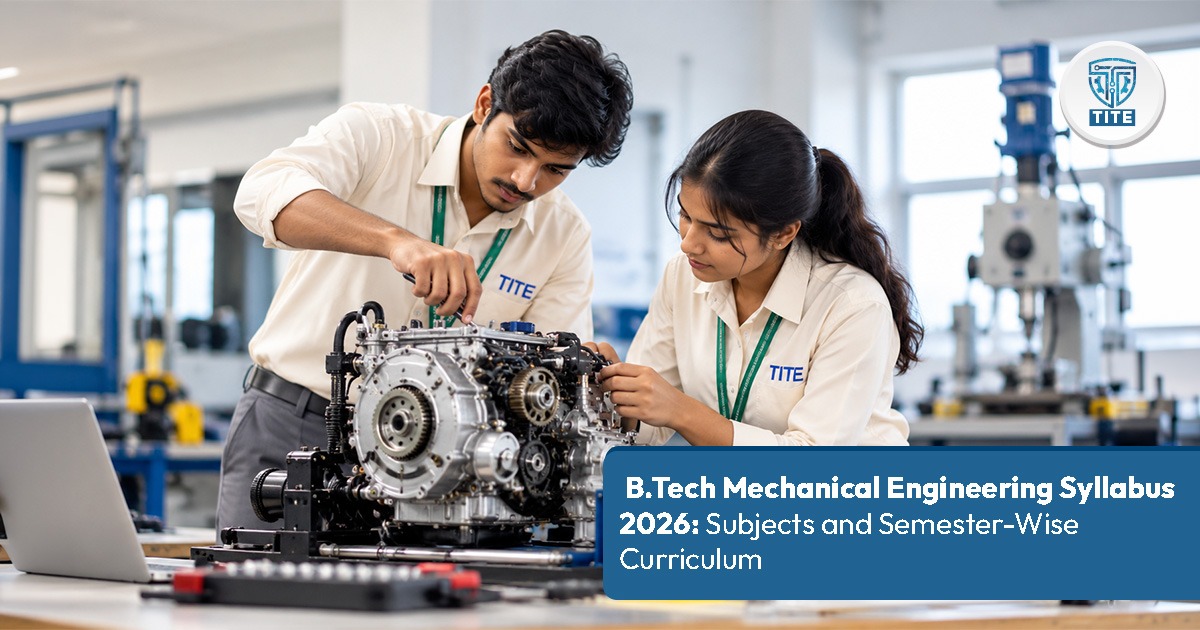
B.Tech Mechanical Engineering Syllabus 2026: Subjects and Semester-Wise Curriculum
Mechanical Engineering has changed, but its basic purpose has not.
It is still about understanding how physical systems work and using that knowledge to design, manufacture, test and improve them. What has changed is the range of tools now available to engineers.
Today, mechanical work can move from drawing to CAD, from machining to CNC, and from traditional production to more automated manufacturing systems.
That makes the B.Tech Mechanical Engineering syllabus interesting to read in 2026. It shows how students build the fundamentals first and then learn to apply them in a more modern engineering environment.
What Does a Mechanical Engineering Degree Actually Build?
Mechanical Engineering brings together several ways of looking at the same problem.
A component has a shape, but it also has a material. It carries forces, may experience heat, has to be manufactured, and must continue working safely.
That is why the course moves across areas such as:
- mechanics and material behaviour
- fluids and thermal systems
- machine design
- manufacturing processes
- engineering graphics
- workshop and laboratory learning
These Mechanical Engineering subjects are not meant to stay separate. As the course progresses, students begin using one area to understand another.
How Does the Curriculum Change Across Eight Semesters?
The course becomes easier to understand when the eight semesters are viewed as four stages rather than eight different subject lists.
For the exact paper names and batch-wise academic structure, students should refer to the official BPUT syllabus. BPUT publishes Mechanical Engineering curriculum documents according to semester and admission batch.
| Stage | Main Learning Focus | What Changes for the Student |
|---|---|---|
| Semesters 1–2 | Engineering foundation | Learn the basics needed to read, calculate and represent engineering problems |
| Semesters 3–4 | Core Mechanical Engineering | Begin working with forces, materials, fluids and thermal systems |
| Semesters 5–6 | Design and manufacturing | Use earlier concepts to make engineering decisions |
| Semesters 7–8 | Application and projects | Bring several subject areas together around practical problems |
This progression matters more than memorising a long list of papers before admission.
Semesters 1 and 2: Building an Engineering Base
The first year gives students the language needed for the rest of the degree.
Engineering Graphics, mathematics, science and workshop-oriented learning help students become comfortable with technical drawings, measurements, calculations and basic engineering practices.
For a Mechanical Engineering student, this base matters later when components have to be designed or manufactured.
A drawing is not simply a sketch. It has to communicate dimensions and form accurately enough for somebody else to understand what needs to be made.
Semesters 3 and 4: The Mechanical Core Becomes Clearer
The second year takes students closer to the physical behaviour of machines and systems. TITE's current Mechanical Engineering programme identifies Mechanics of Solids, Fluid Mechanics, Thermal Engineering and Applied Mechanics among its core academic areas.
These areas answer very different questions. Mechanics looks at forces and deformation. Fluid Mechanics deals with liquids and gases. Thermal Engineering brings heat and energy into the picture.
Together, they form the base for later design and manufacturing work.
Which Mechanical Engineering Subjects Matter Most?
There is no single subject that defines the branch.
The more useful way to understand the B.Tech Mechanical subjects is by the problem each group helps students solve.
- Mechanics and materials help explain whether a component can handle the forces acting on it.
- Fluids and thermal systems help explain pressure, flow, heat and energy within mechanical systems.
- Design turns engineering requirements into components and systems.
- Manufacturing deals with how those designs can actually be produced.
- Graphics and workshop learning connect technical ideas with physical form and fabrication.
Once students see these connections, the syllabus feels much less like a collection of unrelated subjects.
Semesters 5 and 6: From Understanding to Making Decisions
By the third year, the nature of the learning starts to change. Students are no longer only trying to understand why something behaves in a certain way. They also begin thinking about how it should be designed.
A mechanical component may need to satisfy several requirements at once:
- suitable material
- adequate strength
- correct dimensions
- safe operation
- practical manufacturing
- reliable performance
This is where earlier subjects begin working together.
Mechanics may explain the load. Material knowledge helps with selection. Engineering drawing communicates the design, while manufacturing determines whether that design can be produced effectively.
Why Manufacturing Is Central to the Course
Mechanical Engineering does not stop once a design is complete. Students also need to understand what happens when that design reaches a workshop or production environment. Manufacturing therefore connects ideas with processes such as machining, fabrication and production.
For students considering TITE, the current programme lists practical exposure to machining, welding, carpentry and fabrication, along with lathes, milling machines and CNC technology.
The B.Tech Mechanical Engineering programme page gives a broader view of how the academic programme connects with practical learning.
Labs Are Where Theory Stops Feeling Abstract
Mechanical Engineering has many concepts that are easier to understand when students can test or observe them.
Material behaviour, fluid flow, machine movement and heat transfer all become more meaningful when classroom ideas are supported by experiments.
The current Mechanical Engineering setup at TITE lists facilities including:
- Engineering Workshop
- Engineering Graphics Lab
- Material Testing Lab
- Basic Manufacturing Process Lab
- Theory of Machines Lab
- Design of Machine Elements Lab
- Fluid Mechanics and Hydraulic Machines Lab
- Thermal Engineering Lab
- Heat Transfer Lab
These facilities directly support the main subject areas students encounter during the degree.
Semesters 7 and 8: Using More Than One Subject at Once
The later semesters are where the earlier learning is expected to come together. Instead of treating design, materials or manufacturing as separate topics, students begin working with problems that may require several areas at the same time.
A project can move through a simple engineering cycle:
Problem → Analysis → Design → Material Choice → Build or Model → Test → Improve
That process is closer to real engineering than solving a question from one chapter.
BPUT also published its Mechanical Engineering seventh-semester syllabus for the 2023–24 admission batch in July 2026, showing the continuing batch-wise progression of the formal curriculum.
What Has Changed for Mechanical Engineering in 2026?
The core principles remain familiar, but the manufacturing environment around them is becoming more advanced.
In February 2026, the Government of India began consultation on a proposed Advanced Manufacturing Systems Mission focused on strengthening capabilities across modern manufacturing systems.
The Ministry of Heavy Industries also reported in August 2026 that its SAMARTH centres had trained around 33,000 people while promoting Industry 4.0 and advanced manufacturing capabilities.
For students, this makes one thing clear: Mechanical Engineering is not moving away from its fundamentals. Those fundamentals are increasingly being used inside more automated and digitally supported production environments.
Where Do CAD, CAM and CNC Fit?
Modern Mechanical Engineering often moves between the physical and digital worlds. A component may first be created digitally, then prepared for production and finally manufactured with computer-controlled equipment.
TITE's current Mechanical Engineering information lists exposure to:
- AutoCAD
- SolidWorks Basics
- CAD/CAM Concepts
- CNC Programming Concepts
- Manufacturing Automation
- Quality Control Techniques
- Production Planning Fundamentals
These are useful because they sit alongside design and manufacturing rather than replacing them.
Students can review the Mechanical Engineering practical-learning details to see the listed tools, laboratories and workshop environment.
Why Are Automation and Advanced Manufacturing Relevant?
Automation is becoming part of the wider engineering skill environment.
Government skill initiatives in 2026 include areas such as Advanced CNC Machining, CAM Programming, Industrial Robotics and Digital Manufacturing, Manufacturing Process Control and Automation, Mechatronics and FEM-based virtual analysis.
Additive manufacturing is also receiving more attention.
Under PMKVY 4.0, more than 600 courses have been introduced across future-oriented areas including additive manufacturing, AI and IoT, with more than 5.44 lakh candidates trained by June 2026.
For Mechanical Engineering students, these developments add new tools around familiar engineering problems.
What Should You Look for Beyond the Subject Names?
A syllabus can tell you what has to be studied. It cannot tell you the full learning experience. For Mechanical Engineering, it is worth checking whether the academic subjects are supported by opportunities to draw, test, manufacture and work with real systems.
A useful programme comparison should include:
- laboratories linked with core subjects
- workshop practice
- manufacturing exposure
- CAD/CAM and CNC learning
- project-based work
- industrial visits
- internships
TITE's current Mechanical Engineering information lists workshops, laboratories, industrial visits, internships and project-based learning around the academic programme.
How Can You Tell If Mechanical Engineering Suits You?
Mechanical Engineering does not require you to arrive already knowing how machines work. It does help if you enjoy understanding physical problems and asking how something could work better.
You may connect with the course if you find questions like these interesting:
- Why did this part fail?
- Could the design be stronger or lighter?
- Which material would work better?
- How can the part be manufactured?
- What happens when heat or pressure changes?
- How can the process become more efficient?
The degree mixes analytical thinking with practical engineering. Students who enjoy both sides often find the subject easier to connect with.
A Better Way to Read the Mechanical Engineering Syllabus
Do not try to understand every course title before admission. Instead, look at what the curriculum is building towards. The early semesters should give you enough engineering foundation to understand later problems. The middle semesters should build your knowledge of mechanics, materials, thermal systems, fluids, design and manufacturing.
The final stage should give you opportunities to use those areas together. That progression is the real value of a semester-wise Mechanical Engineering syllabus.
What Should Four Years Leave You With?
At the start of the degree, a machine may simply look like a collection of parts. By the end, you should be able to ask much better questions about it.
Why was that material chosen? What load is acting on the part? How was it manufactured? Where might it fail? Could the design or production method be improved?
That is what B.Tech Mechanical Engineering gradually builds.
The subjects, labs and newer tools all support the same outcome: learning to understand a physical engineering problem well enough to work towards a practical solution.
Frequently Asked Questions
1. Which semester has core Mechanical Engineering subjects?
Core Mechanical subjects usually become more prominent from the second year onward.
2. Is Thermodynamics part of Mechanical Engineering?
Yes. Thermal Engineering and related heat and energy concepts are important parts of the course.
3. When do students study Machine Design and Manufacturing?
These areas usually become more important in the middle and later semesters.
4. Does Mechanical Engineering include CAD and CNC?
Yes. Modern Mechanical Engineering increasingly includes CAD, CAM, CNC and manufacturing automation exposure.
5. Is practical work important in Mechanical Engineering?
Yes. Labs, workshops, projects and industrial exposure help students apply what they learn in class.
