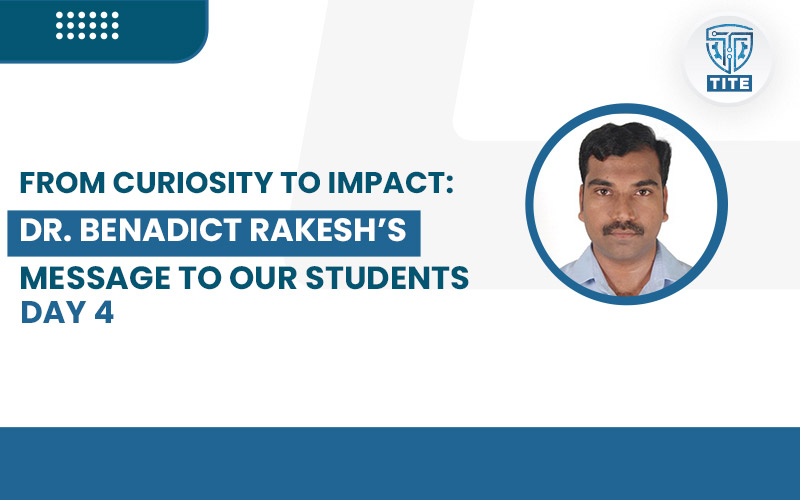
From Curiosity to Impact: Dr. Benadict Rakesh’s Message to our Students
Event Background
An induction programme is more than an introduction to a new institution. It is an opportunity for the students to understand the possibilities that lie ahead and to begin their academic journey with the right mindset. At the TITE Induction Programme, our students had the opportunity to engage with experienced scientists and researchers whose journeys offered perspectives extending beyond conventional classroom learning.
The programme featured an insightful interaction with Dr. Benadict Rakesh, Scientist, Hydro, Bio & Electrometallurgy Department, CSIR-Institute of Minerals and Materials Technology (CSIR-IMMT), Bhubaneswar. His research journey provided the students with an insightful example of how curiosity, adaptability and specialised knowledge can come together to address complex real-world challenges.

About Dr. Benadict Rakesh/Author’s Bio
Dr. Benadict Rakesh is a scientist working in the areas of critical-metal recovery, solvent extraction and materials research. He completed his M.Sc. in Organic Chemistry from the University of Madras, Chennai, in 2010 and pursued his doctoral research at the Indira Gandhi Centre for Atomic Research (IGCAR), Kalpakkam. He completed his doctoral studies in Chemistry at the Homi Bhabha National Institute, receiving his Ph.D. in 2016.
During his doctoral research, he worked on the development of phosphorus-based extractants for monazite ore processing and the separation of zirconium and hafnium. He subsequently worked as a Post-Doctoral Fellow at IIT Madras, where his research expanded into nanomaterials for solar cells, lithium-ion batteries and thermoelectric applications.
At CSIR-IMMT, his work focuses on the solvent extraction and purification of critical metals such as vanadium, nickel, cobalt and rare earth metals from primary and secondary resources as well as potential waste materials.
Encouraging to Think Beyond a Single Discipline
Drawing from his own academic and research journey, Dr. Rakesh offered our students an example of the possibilities that emerge when one remains open to learning beyond a single area of specialisation. His transition from organic chemistry to nuclear research, nanomaterials and critical-metal recovery demonstrates that academic foundations can become stepping stones to diverse fields when accompanied by curiosity and a willingness to adapt.
Rather than viewing their chosen discipline as a fixed boundary, students can approach their college years as an opportunity to discover connections between different fields and understand how diverse areas of knowledge can work together to solve complex problems.
Approach Real-World Challenges
A significant takeaway from Dr. Rakesh's research experience is the importance of connecting knowledge with practical challenges. His work on recovering critical metals from primary resources, secondary resources, and waste materials reflects the growing need for sustainable approaches to resource management.
Sharing an important perspective on problem-solving, he encouraged the students to “look at problems not merely as obstacles but as opportunities for innovation.” Materials that are overlooked or considered waste potentially become valuable resources when approached through scientific research and technological development.”
His experience with materials for solar cells, lithium-ion batteries, and thermoelectric applications also highlights the role that emerging technologies can play in addressing future energy and sustainability challenges. Such examples helped our students to demonstrate how classroom concepts can eventually contribute to technologies with practical and societal relevance.
Building Adaptability Alongside Expertise
Dr. Rakesh's career also reinforces the importance of continuously developing one's capabilities. His movement across different research areas shows that professional growth does not always follow a straight line. It can involve learning new techniques, entering unfamiliar fields, and adapting one's expertise to emerging challenges.
He mentioned that “Building a strong foundation is important, but remaining willing to learn, unlearn, and adapt is equally significant in a rapidly changing technological landscape.”
Inspiring the Next Generation of Problem-Solvers
Dr. Rakesh's interaction added a valuable research and innovation perspective to the Induction Programme. His journey demonstrated how education can evolve into specialised expertise and, ultimately, into solutions for challenges involving energy, resources, materials and sustainability.
His experience encouraged our students to remain curious, explore beyond familiar boundaries and develop the confidence to approach difficult problems. More than simply preparing for a career, their academic years can become an opportunity to develop the mindset of problem-solvers—individuals capable of transforming knowledge and ideas into solutions that can make a meaningful difference.
